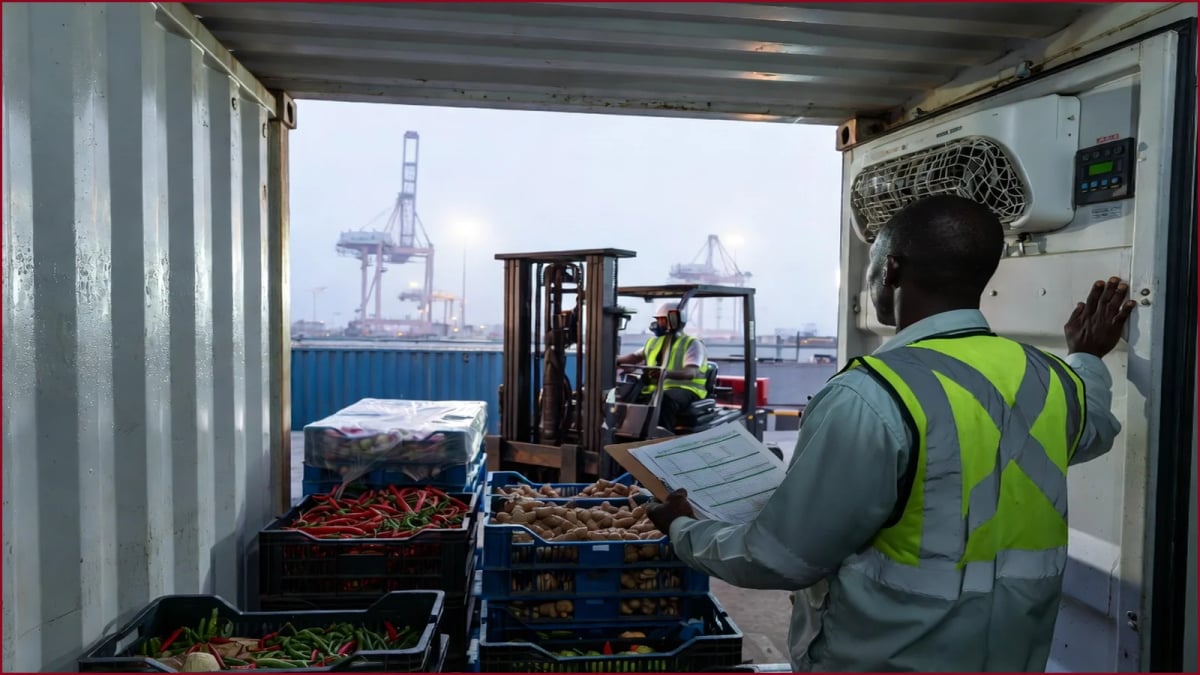
Cold-chain coordination for a perishable commodity export programme
An exporter required cold-chain handling and traceable packaging for a perishable commodity consignment destined for institutional buyers. The Project Office coordinated temperature-controlled storage, lot-level traceability and cargo-ready documentation.
Project Profile
Sector: Perishable commodity export — fresh produce aggregation and cold-chain logistics Programme Scale: Multi-origin aggregation across three sourcing zones in southern Ghana and southern Togo Scope: Farm-gate collection, pre-cooling and cold-store staging, documentation and phytosanitary coordination, port-of-exit logistics management Timeline: Continuous programme, seasonal peak cycle with structured lead-in preparation
The Coordination Challenge
Fresh produce destined for institutional export buyers operates under conditions that punish organisational gaps severely. Temperature deviation, documentation delays, and aggregation lag each carry consequences that compound before the consignment reaches the port gate.
This programme involved a development-linked institutional buyer operating a structured offtake arrangement for fresh perishable produce sourced across multiple growing districts in Ghana and Togo. The buyer’s import-country compliance requirements were exacting: unbroken cold-chain evidence, origin traceability to district level, phytosanitary clearance aligned to destination market standards, and consistent parcel sizing across delivery windows.
The challenge was not access to produce. The challenge was engineering a coordinated cold-chain pathway from dispersed farm-gate origins to port exit — at pace, with documentation discipline at every handover, and without the single-point-of-failure vulnerabilities that often characterise regional fresh produce logistics.
Approach
Kronix Agri structured the programme around four interlocking coordination layers.
Aggregation sequencing — collection schedules were aligned to cooling facility availability, preventing holding time at ambient temperature. Farmer-facing teams documented lot identity, harvest date, and volume at point of collection.
Pre-cooling and staging — produce moved into cold-store facilities within a controlled time window. Temperature logs were maintained against each lot. Staging was sequenced to consolidation schedules, not ad hoc.
Documentation architecture — phytosanitary inspection coordination, export permits, and traceability records were prepared in parallel with physical staging, not after it. Compliance documents followed the produce through each handover rather than being assembled retrospectively.
Port-logistics coordination — reefer container booking, port health inspection scheduling, and export declaration were managed as a unified sequence rather than separate tasks handed off between parties.
Throughout the programme, each handover point carried documented sign-off — an institutional discipline that allowed the buyer’s quality team to audit the chain without ambiguity.
Outcome
The buyer received consignments meeting destination-market specifications consistently across the peak season cycle. Cold-chain documentation was presented as a complete, unbroken record at each shipment. Phytosanitary clearance was obtained within programme timelines. The traceability record allowed origin-district attribution for the buyer’s own reporting requirements.
The programme demonstrated that multi-origin fresh produce aggregation from Ghana and Togo can meet institutional export standards when coordination is treated as a primary deliverable — not a secondary concern subordinate to volume.
What This Project Demonstrates
Perishable export programmes fail most often at the coordination layer, not at the growing layer. Produce quality achieved at farm level is routinely eroded by aggregation gaps, documentation delays, and cold-chain discontinuities before it reaches export inspection.
This programme reflects the operating standard Kronix Agri applies to institutional mandates: traceability-disciplined, documented at every handover, structured to meet the compliance requirements of serious institutional buyers and development-linked offtake programmes. Where the destination demands evidence, the programme generates it — by design, not by recovery.