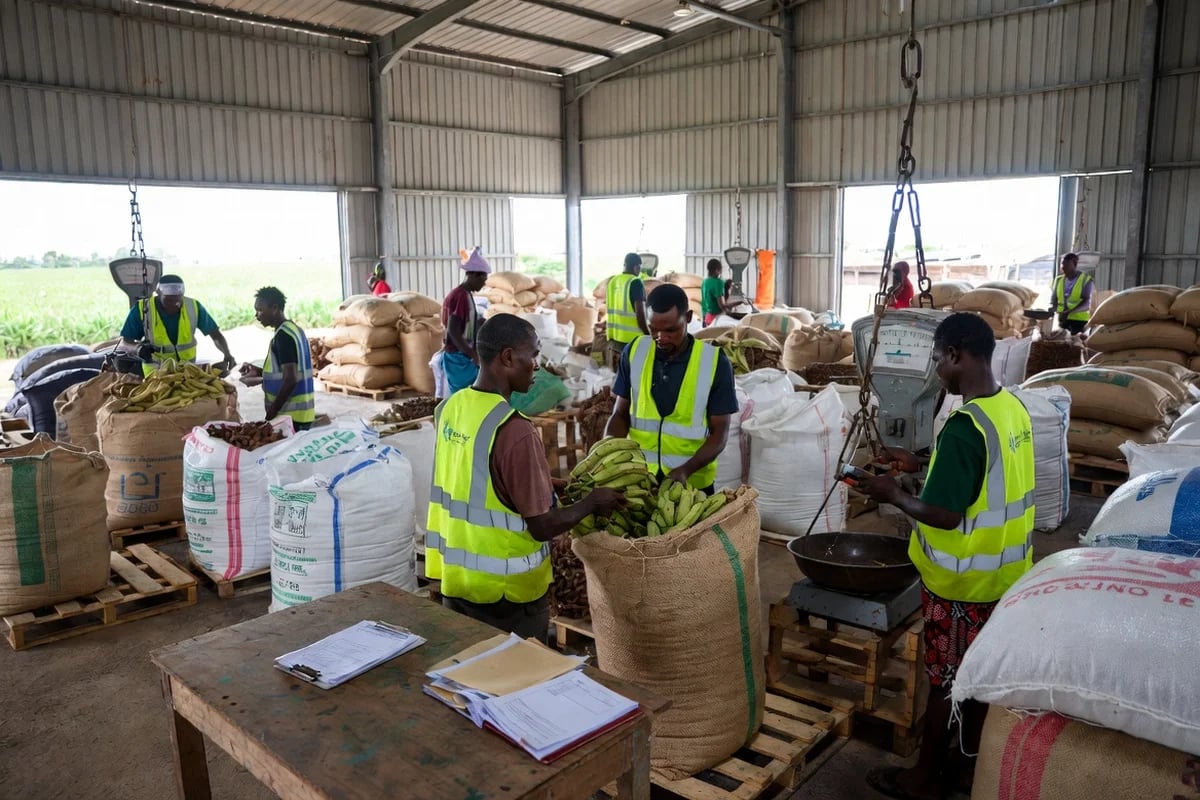
Crop Aggregation & Sourcing
Structured aggregation and sourcing of tropical agricultural commodities from smallholder, cooperative and commercial farm networks across Ghana and Togo, with documented chain-of-custody from farm gate to consolidation point.
How Crop Aggregation Works in Ghana
Getting a tropical crop from a dispersed Ghanaian smallholder network to an export buyer is an aggregation and chain-of-custody problem — and to be clear before anything else: Kronix Agri is a crop-aggregation and sourcing partner, not a plantation. We build documented, graded, export-ready supply from farmers, cooperatives and commercial-farm partners across Ghana and Togo, since 1985. Discuss a sourcing partnership — or request a proposal: +233 20 531 3333 (Togo / Francophone: +228 96 86 86 75).
What is Crop Aggregation & Sourcing?
Crop aggregation and sourcing is the structured discipline of assembling tropical agricultural commodities from geographically dispersed farm networks — smallholder plots, cooperative clusters and commercial farms — into consolidated, documented, export-ready volumes. It is not simply procurement. It is the systematic construction of a supply position: origin-verified, quality-assessed, chain-of-custody documented from the moment a commodity leaves the farm gate to the point it arrives at a consolidation facility ready for the next stage of its journey.
Institutional buyers, food processors, export houses and development programme administrators specify this service when they require supply reliability that a single-source procurement model cannot deliver. The discipline sits at the intersection of field logistics, quality governance and documentation rigour — and it demands a specialist operating presence across both Ghana and Togo to function as intended.
When to Specify Crop Aggregation & Sourcing
This service is the appropriate specification for any institution or programme whose commodity requirements exceed what a single cooperative or commercial farm can consistently supply at the required quality grade. Export-readiness mandates — whether driven by buyer specifications, import-country phytosanitary requirements or programme compliance frameworks — demand that every volume in the supply chain be individually accountable. Aggregation structures that lack documented chain-of-custody at each handover create audit exposure and buyer-confidence risk.
Food processors operating seasonal campaigns, export trading houses managing forward contracts, and development programmes disbursing inputs and offtake guarantees across smallholder networks all share the same structural requirement: supply assembled with discipline, documented with precision, and delivered on schedule. Across Ghana and Togo, this is the operating environment Kronix Agri is built to serve.
Methodology — The Kronix Agri Specialist Approach
-
Origin Mapping & Network Registration — Candidate farm networks, cooperatives and commercial farm partners across the relevant producing corridors are assessed and registered. Farm-level profiling documents production capacity, crop variety, seasonal calendar and prevailing agronomic practices.
-
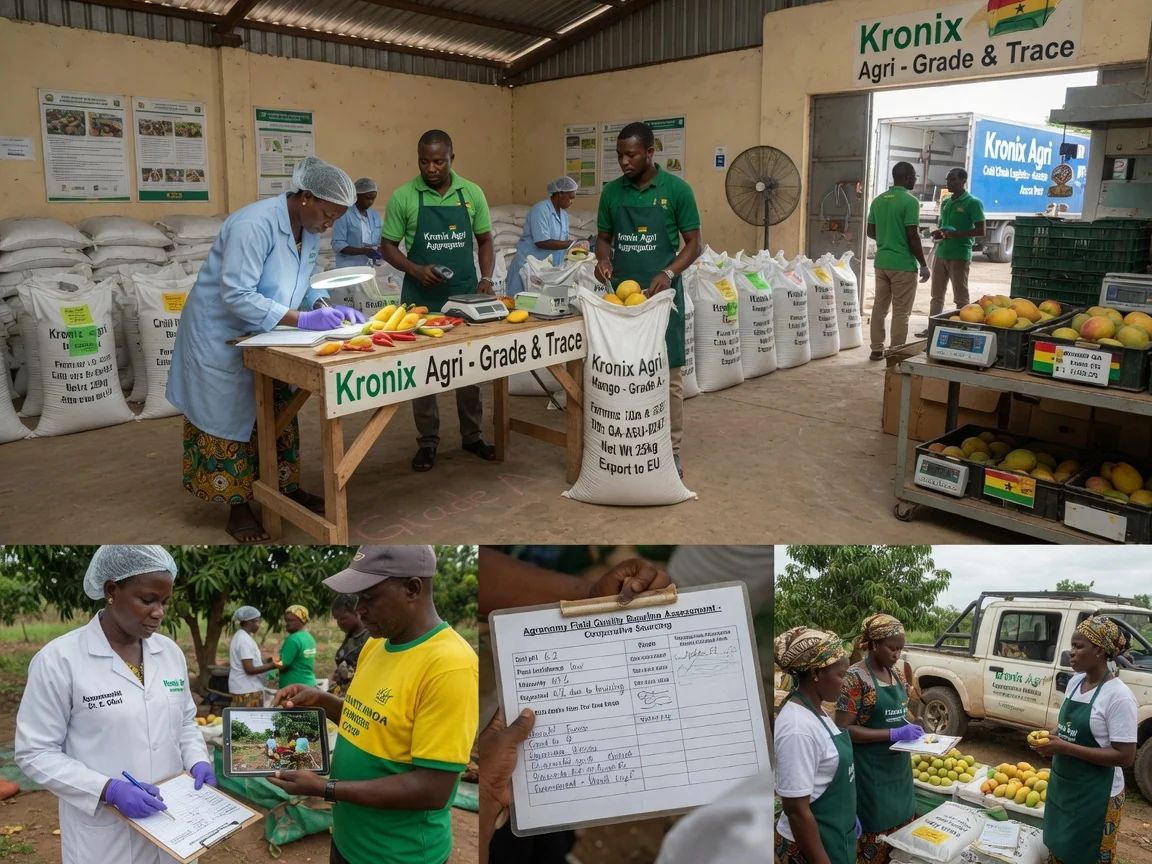
Quality Baseline Assessment — Commodity samples are evaluated against the applicable buyer specification or programme standard. This establishes the quality threshold governing the aggregation exercise and creates the reference point for all subsequent field-level acceptance decisions.
-
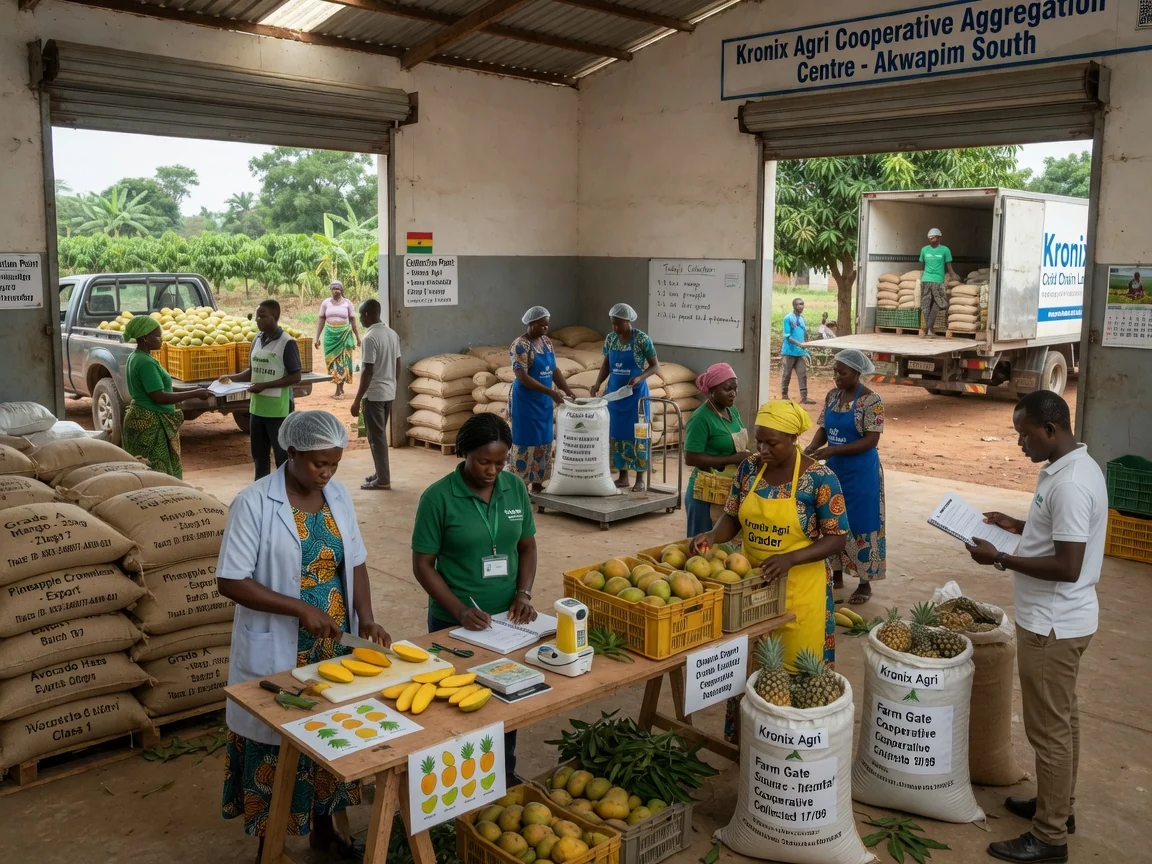
Field Mobilisation & Farm-Gate Collection — Specialist field coordinators execute structured collection runs across registered farm points. Each collection event is documented: farm identity, volume received, quality assessment, and handover confirmation — creating an unbroken chain-of-custody record from the first point of aggregation.
-
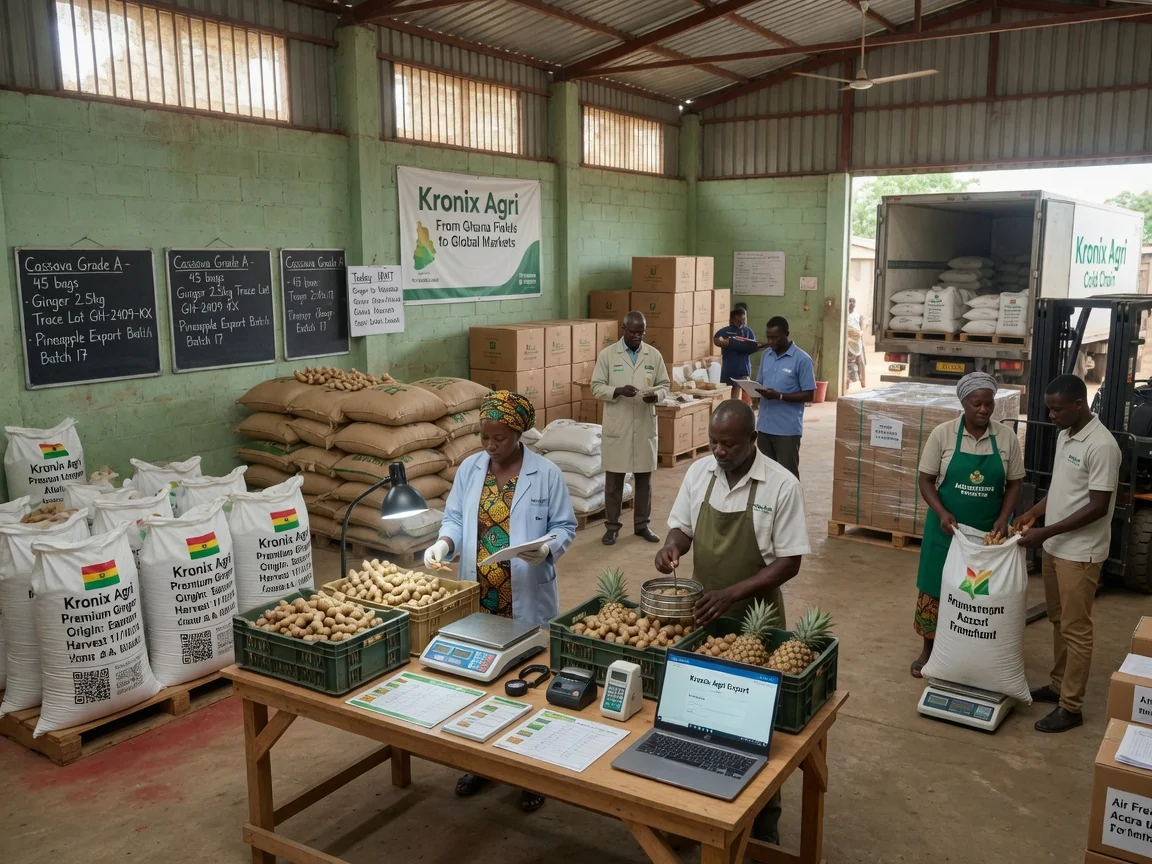
Consolidation & Sorting at Designated Facilities — Collected volumes are transported to consolidation points where secondary quality sorting, moisture assessment and grading take place. Lots are assembled to match the buyer or processor specification and held in documented inventory.
-
Documentation Pack Assembly & Handover — Prior to dispatch to the next supply chain stage, a complete documentation pack is assembled: origin records, quality assessment summaries, lot-level chain-of-custody documentation, and any phytosanitary or buyer-required certificates. Handover is formalised, not assumed.
Supply Standards & Traceability Framework
- Farm-level registration and origin documentation for all participating supply network members
- Commodity-specific quality acceptance criteria aligned to buyer or processor specification
- Unbroken chain-of-custody records from farm gate through consolidation to dispatch
- Moisture, grade and visual assessment conducted at each quality checkpoint
- Lot segregation protocols preventing commingling of registered and unregistered supply
- Documentation packs assembled to support export-readiness, institutional audit and programme compliance requirements
Outcomes & Supply Reliability
Institutions that specify structured aggregation receive a supply position they can audit, report against and present with confidence to buyers, import-country authorities and programme monitors. Volume reliability, quality consistency and documentation completeness are the three disciplines that define whether an aggregated supply position is genuinely export-ready or merely physically assembled. Kronix Agri’s approach treats all three as non-negotiable, with each field cycle generating records that hold under institutional scrutiny.
Compliant & To Standard
- We work within the relevant Ghanaian regulatory regime for each crop — the Tree Crops Development Authority (TCDA) for crops such as cashew, shea and rubber, COCOBOD’s licensed regime for cocoa, and PPRSD phytosanitary requirements for export — and describe our role and certifications honestly, never a licence we do not hold
- Export-readiness support toward standards such as GLOBALG.A.P / HACCP / Ghana Standards Authority where they apply, with honest status (held vs in progress)
- Established 1985 — a real crop-aggregation and sourcing partner, serving exporters, processors, institutional buyers and development programmes across Ghana, Africa and the Lomé corridor — not a plantation
Related Services
- Crop Aggregation & Export — Ghana — the full origin-to-export picture
- Quality Assurance & Grading — to the buyer’s specification
- Post-Harvest Handling & Cold Chain — preserve quality from farm gate
- Contract Farming Coordination — quality built at source
- Agro-Logistics & Distribution — documented movement to the buyer