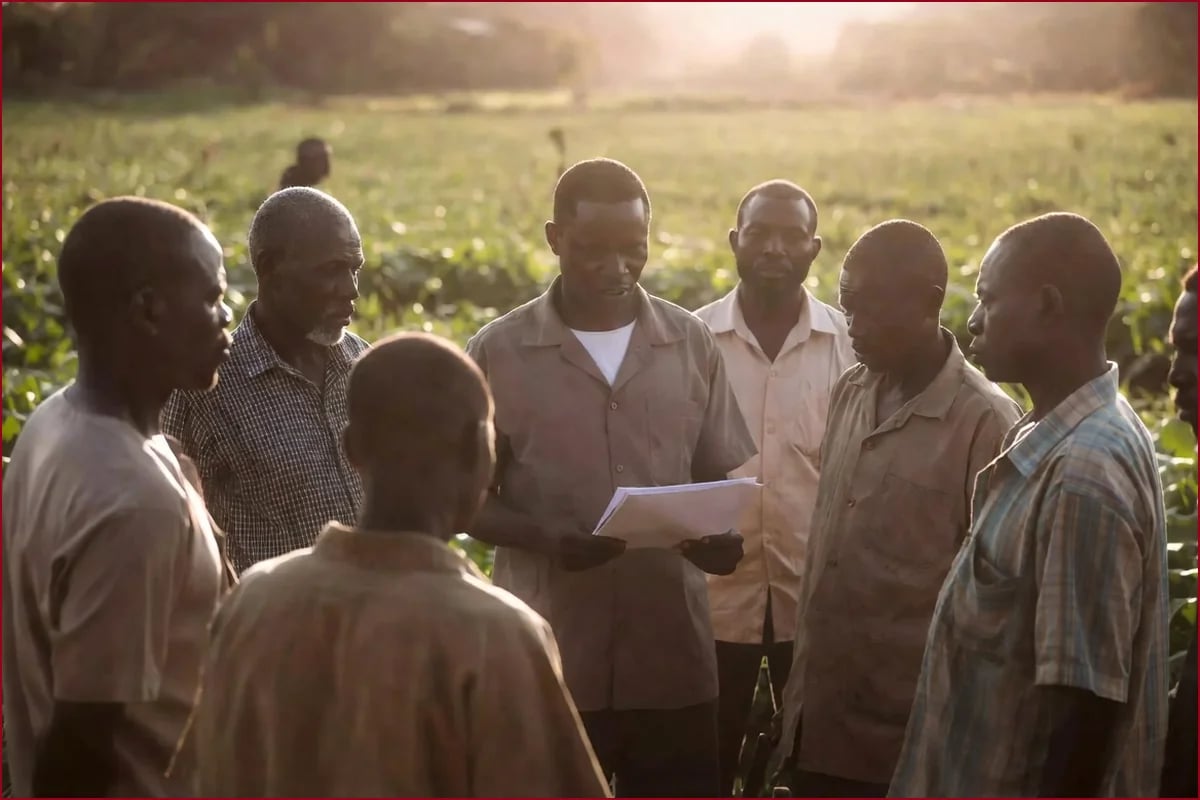
Why Smallholder Cooperative Networks Specify Kronix Agri
Cooperative structures occupy a structurally complex position in the agricultural supply chain. They aggregate across dozens or hundreds of individual producers, each operating at different scales and soil conditions, yet they must present a consolidated, documentable commodity to institutional buyers and export processors who require uniformity, traceability, and consistent quality across every delivery. The gap between farm-level production and market-ready specification is where value is either captured or lost entirely.
Kronix Agri’s contract-farming coordination and agronomy advisory service is built precisely for that gap. Cooperative networks that engage through this sector benefit from structured coordination protocols — aligning planting schedules, input timing, and harvest logistics to the requirements of the downstream buyer, not the other way around. The discipline runs from field registration and input advisory through to aggregation-point grading and handover documentation, so the commodity that leaves the cooperative is the commodity the market was promised.
Specification Requirements Unique to Smallholder Cooperatives
Institutional buyers and export processors operating in Ghana and Togo apply exacting standards that individual smallholders, operating in isolation, cannot reliably meet. Residue thresholds, moisture content tolerances, grade homogeneity, and lot traceability requirements are standard expectations at the procurement level — and they do not accommodate informal documentation or inconsistent husbandry practices across a producer network.
For cooperative networks, the challenge compounds: the more dispersed the producer base, the wider the variance in outcome unless coordination is active and documented. Kronix Agri’s advisory approach treats agronomic alignment — consistent input use, timing, and post-harvest handling — as a non-negotiable baseline, not an optional enhancement. Every coordinated programme is structured so that compliance documentation is built into the process from registration, not retrofitted at the point of sale.
Recommended Services for Smallholder Cooperatives
- Contract-Farming Coordination — structured agreements linking cooperative producer groups to downstream volume commitments, with aligned agronomic calendars and clear handover conditions
- Field-Level Agronomy Advisory — specialist advisory deployed at producer level to standardise input practices, address crop-health variance, and align husbandry to export-market specifications
- Aggregation-Point Quality Grading — systematic grading and sorting at collection centres to ensure grade homogeneity before commodities enter the processing or logistics chain
- Traceability Documentation & Lot Management — field-to-gate documentation protocols that record producer identity, input history, harvest timing, and grade outcome for each aggregated lot
- Export-Readiness Processing Coordination — coordination with downstream processors to ensure post-harvest handling, moisture management, and packaging meet the receiving market’s intake requirements
Notable Project Types
Kronix Agri has coordinated multi-village producer networks across Ghana and Togo where individual holdings are small but collective volume is institutionally significant. These programmes typically begin with field registration across the cooperative’s producer membership, followed by agronomic calendar alignment and structured input advisory — culminating in scheduled aggregation cycles timed to buyer intake windows. The result is a supply flow that the institutional buyer can plan against, rather than react to.
A second recurring engagement type involves cooperatives transitioning from informal buyer relationships toward formal export-market programmes — often in conjunction with development programme procurement standards or food-processor supply agreements. These engagements require a systematic documentation retrofit alongside concurrent agronomic standardisation, both of which Kronix Agri coordinates as an integrated advisory mandate rather than separate service lines.
Compliance & Standards Orientation
- Adherence to Ghana Food and Drugs Authority commodity handling requirements where applicable to processed or semi-processed outputs
- Alignment with phytosanitary documentation requirements governing crop movement across the Ghana–Togo corridor
- Moisture content and grade specification compliance calibrated to the receiving market’s documented intake standards
- Lot-level traceability records maintained at each aggregation and handover point, supporting audit and buyer verification
- Input-use records structured to support residue compliance documentation required by institutional and export-market buyers
- Producer registration and field mapping maintained as baseline records for each coordinated programme
Sourcing for Farmer Cooperatives
The coordination and quality services that turn a producer network into an export-ready supply:
- Crop Aggregation & Export Facilitation — the full source-to-shipment service
- Crop Aggregation & Sourcing — documented, traceable origin supply
- Post-Harvest Handling & Cold Chain — quality preserved from farm gate
- Quality Assurance & Grading — grade homogeneity to specification
- Export-Readiness & Certification Support — phytosanitary and documentation
Compliant & To Standard
Kronix Agri is an aggregation and export-facilitation partner working alongside cooperative networks — not a plantation. We coordinate, advise, and document; we do not own the land or the crop. We work within the relevant Ghanaian regulatory regime for each crop (the Tree Crops Development Authority for crops such as cashew and shea, COCOBOD’s licensed regime for cocoa, and PPRSD phytosanitary requirements for export), and we describe our role and certifications honestly — never a licence or standard we do not hold. Where standards such as GLOBALG.A.P or HACCP apply, we support readiness toward them and state plainly what is held versus in progress.
Discuss a sourcing partnership — or request a proposal: +233 20 531 3333.