
Quality Assurance & Grading
Commodity grading, sorting and quality-assurance protocols applied at each stage of the aggregation and export-readiness process, with documentation provided at every handover.
A graded, documented lot carries its own verification — it speaks to the institutional buyer before any conversation begins. Quality assurance and grading is the foundational discipline on which every downstream transaction rests: sorting by size, colour, and defect; moisture and contamination assessment; and the documentation that travels with each consignment. To be clear before anything else: Kronix Agri is an aggregation and export-facilitation partner, not a plantation. We grade crops sourced from farmers and cooperatives to the buyer’s specification, since 1985. Discuss a sourcing partnership — or request a proposal: +233 20 531 3333 (Togo / Francophone: +228 96 86 86 75).
What is Quality Assurance & Grading?
Quality assurance and grading is the systematic application of commodity-evaluation protocols at every handling stage — from primary aggregation point through pre-export conditioning. It encompasses physical sorting by size, colour and defect profile; moisture and contamination assessment; lot separation by grade designation; and the generation of handover documentation that accompanies each consignment from intake to dispatch.
Institutional buyers, export-licence holders, food processors and development-programme procurement desks specify this service because they require commodities that arrive within defined quality windows — not as approximated field-run lots. For exporters operating under buyer-side quality clauses and processors managing throughput consistency, grading is not an optional enhancement. It is the foundational discipline on which every downstream transaction rests.
When to Specify Quality Assurance & Grading
This service is relevant whenever a commodity changes hands under a specification obligation — whether the destination is a food manufacturer requiring clean, sorted input material, a foreign buyer whose import standards carry rejection risk, or a development programme with traceability mandates built into its procurement terms. It applies equally to bulk aggregation flows and smaller lot consolidations where grade consistency determines contract fulfilment.
Across the Ghana and Togo supply corridors, the service is most frequently engaged at the point where field-aggregated volume moves into export-readiness processing — the stage at which accumulated variability from multiple collection points must be resolved into a documentable, homogeneous lot.
Methodology — The Kronix Agri Specialist Approach
-
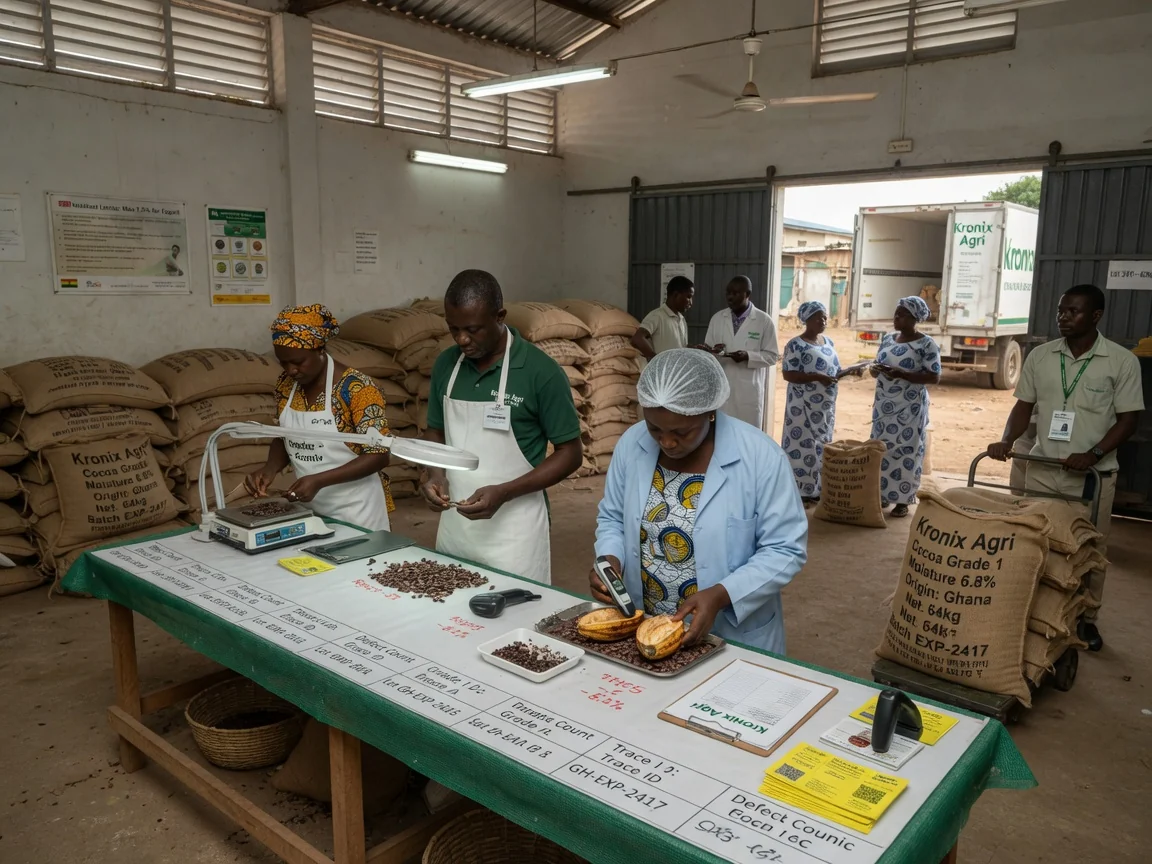
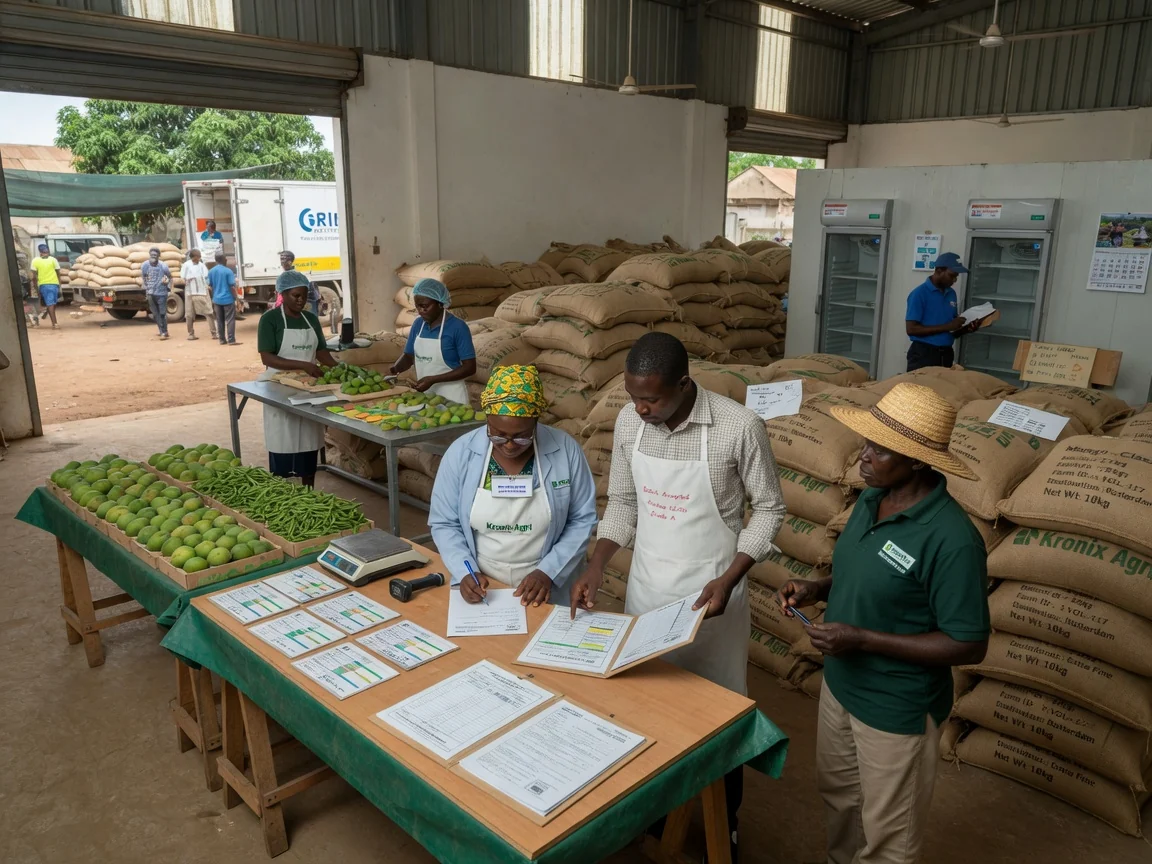
Intake Assessment. Each arriving lot is logged, weighed and subjected to initial visual and instrument evaluation. Moisture readings, foreign-matter presence and gross defect rates are recorded before any further handling begins.
-
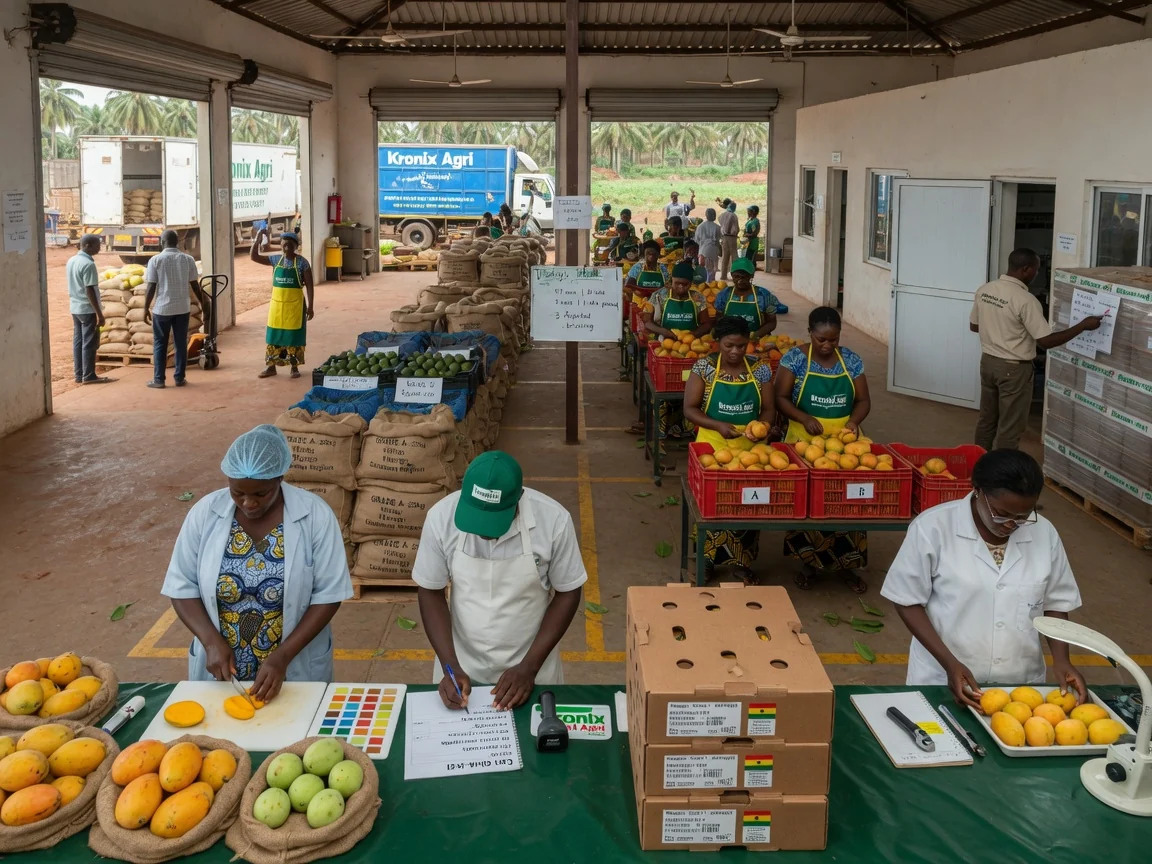
Grade Classification. Lots are assessed against the applicable commodity-specific grade criteria — physical dimension, colour uniformity, defect tolerance and permitted moisture range. Material is designated to a grade tier before sorting commences.
-
Sorting and Separation. Graded lots are physically separated and held in designated storage bays to prevent cross-contamination. Downgraded material is logged separately with disposition instructions noted at that stage.
-
Conditioning and Re-inspection. Where conditioning is required — drying, cleaning, or further size separation — the material undergoes a second evaluation pass after conditioning is complete. Only material meeting the target specification proceeds to outbound preparation.
-
Documentation and Handover Sign-off. A quality record accompanies every released lot, documenting grade designation, assessment date, lot weight, condition notes and the specialist responsible for sign-off. This record travels with the consignment and is available for buyer-side or programme-audit review.
Protocols & Reference Standards
- Commodity-specific physical grading criteria aligned with applicable export-destination import requirements
- Moisture assessment at intake, post-conditioning and pre-dispatch
- Foreign-matter and defect-rate tolerances documented per lot, not averaged across consignment
- Chain-of-custody documentation maintained at every internal handover point
- Lot segregation discipline: no commingling of grade designations once classified
- Rejection and disposition records held for audit access
Outcomes for Buyers and Exporters
Consignments processed under this discipline reach their buyers with documentation that supports acceptance, not inspection dispute. For exporters, this reduces rejection exposure at destination ports. For food processors, it enables throughput planning against known input quality. For development-programme procurement, it provides the audit trail that programme compliance officers require.
The practical outcome of a graded, documented lot is one that carries its own verification — a consignment that speaks to the institutional buyer before any conversation needs to begin.
Compliant & To Standard
- We work within the relevant Ghanaian regulatory regime for each crop — the Tree Crops Development Authority (TCDA) for crops such as cashew and shea, COCOBOD’s licensed regime for cocoa, and PPRSD phytosanitary requirements for export — and describe our role and certifications honestly, never a licence we do not hold
- Grading aligned with applicable export-destination import requirements, with readiness toward standards such as GLOBALG.A.P / HACCP / Ghana Standards Authority where they apply, stated as held vs in progress
- Established 1985 — a real crop-aggregation and export-facilitation partner, not a plantation — grading for exporters, processors, institutional buyers, and development programmes across the Ghana–Togo corridor
Related Services
- Crop Aggregation & Sourcing — structured field-collection and lot-consolidation upstream of grading
- Post-Harvest Handling & Cold Chain — quality preserved before grade is resolved
- Packaging & Traceability — lot identity carried through packaging and records
- Export-Readiness & Certification Support — pre-shipment documentation
- Agro-Logistics & Distribution — documented movement to port or buyer across Ghana and Togo