The problem
Institutional buyers need a documented, HSE-disciplined source for commodity trade facilitation.
Our approach
Commodity Trade Facilitation
Commodity Trade Facilitation delivered to institutional standard — structured procurement, chain-of-custody discipline, documented handover.
The Challenge
Commodity trade across Ghana and Togo operates at the intersection of agronomic variability, logistical complexity and institutional procurement rigour. Exporters and food processors sourcing tropical crops — cassava, shea, cocoa derivatives, sorghum, soybeans and allied produce — encounter fragmented supply chains where aggregation is informal, quality verification is inconsistent and documentation arrives late or incomplete. For institutional buyers and development programmes operating under compliance mandates, this is not a tolerable condition.
The structural gap is not in the volume of available produce. Ghana and Togo generate substantial agricultural output across their producing belts. The gap is in the architecture that governs how that produce is assembled, verified, processed to export-readiness and handed over with a clean, auditable chain of custody. Without that architecture, procurement officers cannot close purchase orders with confidence, and freight forwarders cannot build consignments that will clear destination inspections without dispute.
Kronix Agri was designed precisely for this gap — not as a broker who facilitates introductions, but as a structured service that takes institutional responsibility for every handover point from aggregation origin through to export-ready delivery.
The Kronix Agri Solution
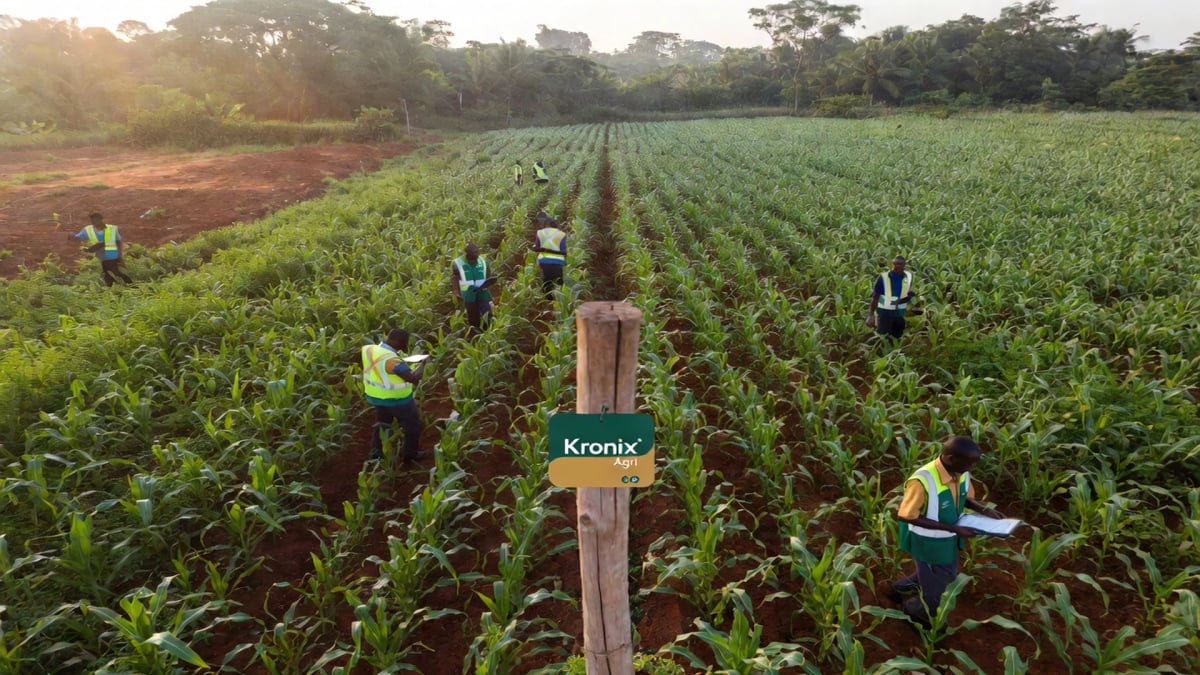
The Kronix Agri commodity trade facilitation methodology is built around documented control at each stage of the supply chain. Procurement begins with structured farmer or cooperative engagement across designated production zones in Ghana and Togo, where crop specifications — moisture content, grade parameters, physical condition — are set before aggregation commences. This pre-procurement discipline ensures that what enters the processing pipeline conforms to buyer specification, rather than buyer specification being adjusted to what arrived.
Processing and conditioning are carried out to export-readiness standards appropriate to each crop class and destination market. Kronix Agri applies traceability protocols that create an unbroken record from aggregation origin to outbound consignment — each handover logged, each quality check documented, each batch identifiable. This chain-of-custody discipline is not a reporting afterthought; it is the core operational methodology.
Logistics coordination — inland movement, warehousing, consignment preparation and export documentation — is managed as an integrated function rather than outsourced to uncontrolled third parties. Institutional buyers and development programme procurement teams receive structured reporting at agreed intervals, with documentation packages that meet the evidentiary requirements of international trade compliance.
Process and System Specification
- Structured farmer and cooperative engagement with pre-set crop specification parameters prior to aggregation
- Quality verification at intake — grade assessment, moisture testing, physical inspection — documented at each origin point
- Chain-of-custody traceability protocol maintaining unbroken batch identity from aggregation through export-ready processing
- Export documentation package: phytosanitary alignment, certificate-of-origin preparation support, consignment manifest, quality attestation
- Inland logistics coordination covering Ghana and Togo corridors, including warehousing and consignment staging
- Compliance-ready handover reporting structured to institutional buyer and development programme procurement requirements
Typical Engagement Profile
A standard Kronix Agri trade facilitation engagement covers multi-origin aggregation across one or more producing zones in Ghana or Togo, processing and conditioning to a defined export specification, and full documentation assembly for a consignment destined for a food processor, commodity exporter or institutional procurement programme. Engagements range from single-crop consignment facilitation with a defined delivery window to multi-cycle procurement programmes operating under framework agreements. Sectors served include food and beverage manufacturing inputs, commodity export trading, development-programme agricultural offtake and institutional food-security procurement.
Outcomes
- Exporters and institutional buyers receive consignments that conform to pre-agreed specifications, with documentation that closes without post-receipt dispute
- Chain-of-custody records provide the traceability evidence required by compliance teams, trade finance institutions and destination-market certification bodies
- Aggregation is executed through disciplined procurement frameworks rather than spot-market improvisation, reducing grade inconsistency across a consignment
- Logistics and export documentation are managed as a coordinated function, reducing the administrative burden on the buyer’s procurement and trade compliance teams
- Development programme procurement officers receive structured reporting that satisfies programme governance and donor-reporting requirements