The problem
Institutional buyers need a documented, HSE-disciplined source for post-harvest handling & cold chain.
Our approach
Post-Harvest Handling & Cold Chain
Post-Harvest Handling & Cold Chain delivered to institutional standard — structured procurement, chain-of-custody discipline, documented handover.
The Challenge
Tropical produce harvested to export specification does not stay that way without a disciplined post-harvest system. Between the farm gate and the freight forwarder’s loading bay, temperature abuse, inadequate curing, improper packaging and undocumented handling transitions erode the quality that buyers contracted and auditors expect. For exporters working the Ghana and Togo corridors, that erosion is not an operational inconvenience — it is a compliance event with real commercial consequence.
Institutional buyers, food processors and development programme procurement officers increasingly impose post-harvest traceability requirements that go beyond visual grading. They require chain-of-custody documentation, temperature and humidity records through each handling stage, and evidence that the produce they receive matches the specification confirmed at origin. Suppliers who cannot produce that documentation at handover are disqualified from tender cycles regardless of the underlying quality of their crop.
The cold chain dimension compounds the challenge further. Across both corridors, infrastructure gaps mean that temperature continuity demands active management rather than passive assumption. A single unmonitored gap — at an aggregation hub, during inland transit, or at a port facility — can compromise an entire consignment without generating a visible defect until the produce is already in-market.
The Kronix Agri Solution
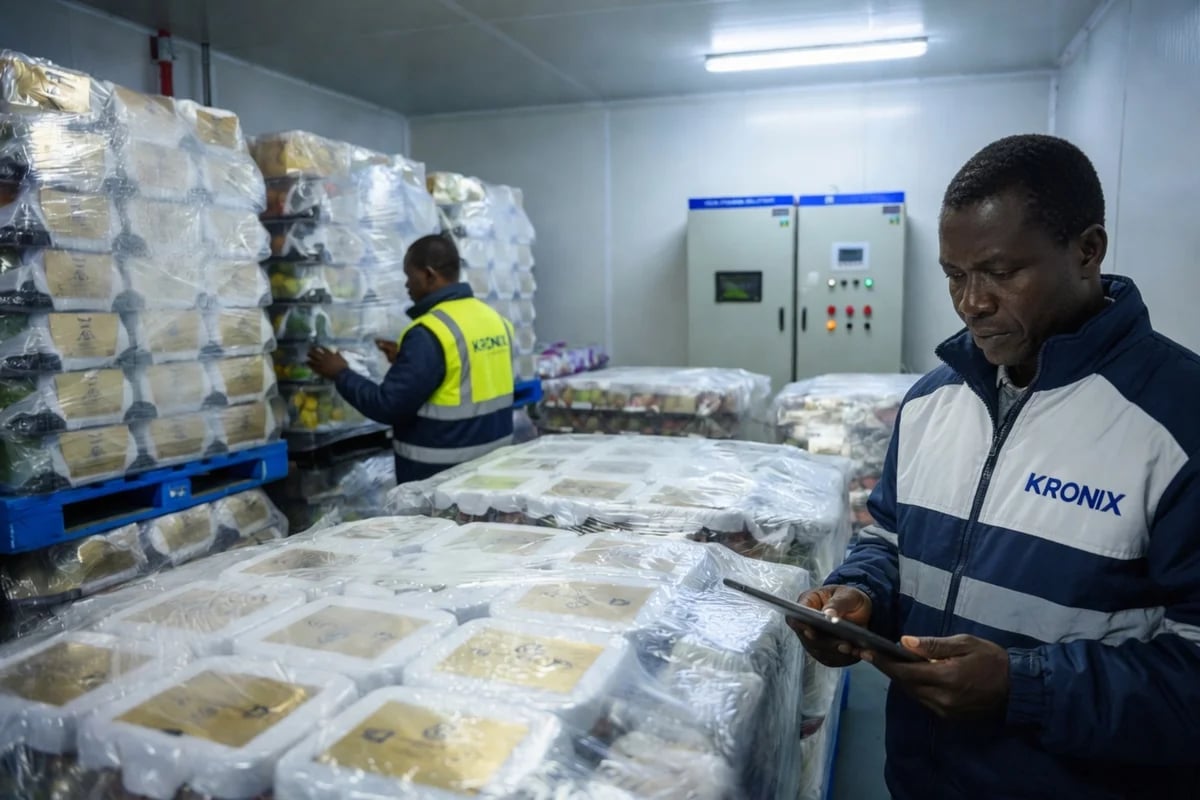
Kronix Agri structures post-harvest handling as a managed process, not a handling task. Each crop type moves through a defined protocol — curing, sorting, grading, conditioning and packaging — calibrated to the phytosanitary and quality parameters the receiving market specifies. Every stage generates a documented record. Every handover requires a confirmed sign-off. The chain of custody is continuous from aggregation point to loading.
Cold chain management is treated as a logistics discipline, not a transport add-on. Kronix Agri coordinates temperature-controlled holding, monitors environmental conditions at critical nodes and sequences inland movement to align with port-side cold infrastructure availability. Where cold chain continuity requires advance coordination with freight handlers, that coordination is built into the dispatch schedule — not improvised at the point of loading.
The result is a post-harvest and cold chain service that allows exporters, food processors and institutional programme managers to procure with documented confidence. The traceability record Kronix Agri produces at the point of export readiness is the same record that travels with the consignment to the receiver.
Process + System Specification
- Stage-by-stage chain-of-custody documentation from aggregation hub to export dispatch
- Crop-specific post-harvest protocols covering curing duration, moisture calibration and grading thresholds
- Temperature and humidity monitoring at critical holding and transit nodes across Ghana and Togo corridors
- Packaging and labelling aligned to receiving-market phytosanitary and presentation requirements
- Coordinated cold-chain sequencing between inland aggregation, transit legs and port-side cold facilities
- Structured handover records suitable for institutional buyer audit and development programme compliance review
Typical Project Profile
A typical engagement involves an exporter or institutional programme manager procuring a defined volume across one or more crop categories — commonly roots and tubers, legumes, or dried horticultural produce — requiring movement from aggregation points in Ghana, Togo, or both to an export-ready condition at a designated dispatch facility. Kronix Agri manages the post-harvest protocol, cold chain continuity and documentation from the point of receipt through to confirmed export readiness. Timelines are determined by crop type, volume and receiving-market specification, and are confirmed in writing at the commencement of each engagement.
Outcomes
- Produce arrives at export dispatch in the condition and specification confirmed at origin
- Chain-of-custody documentation supports institutional buyer audit requirements and development programme compliance obligations
- Temperature and handling records provide evidence of cold chain continuity at every critical node
- Exporters reduce the risk of quality-based rejection or compliance disqualification at the receiving end
- Programme managers and procurement officers receive a structured traceability file, not a verbal assurance, at the point of handover