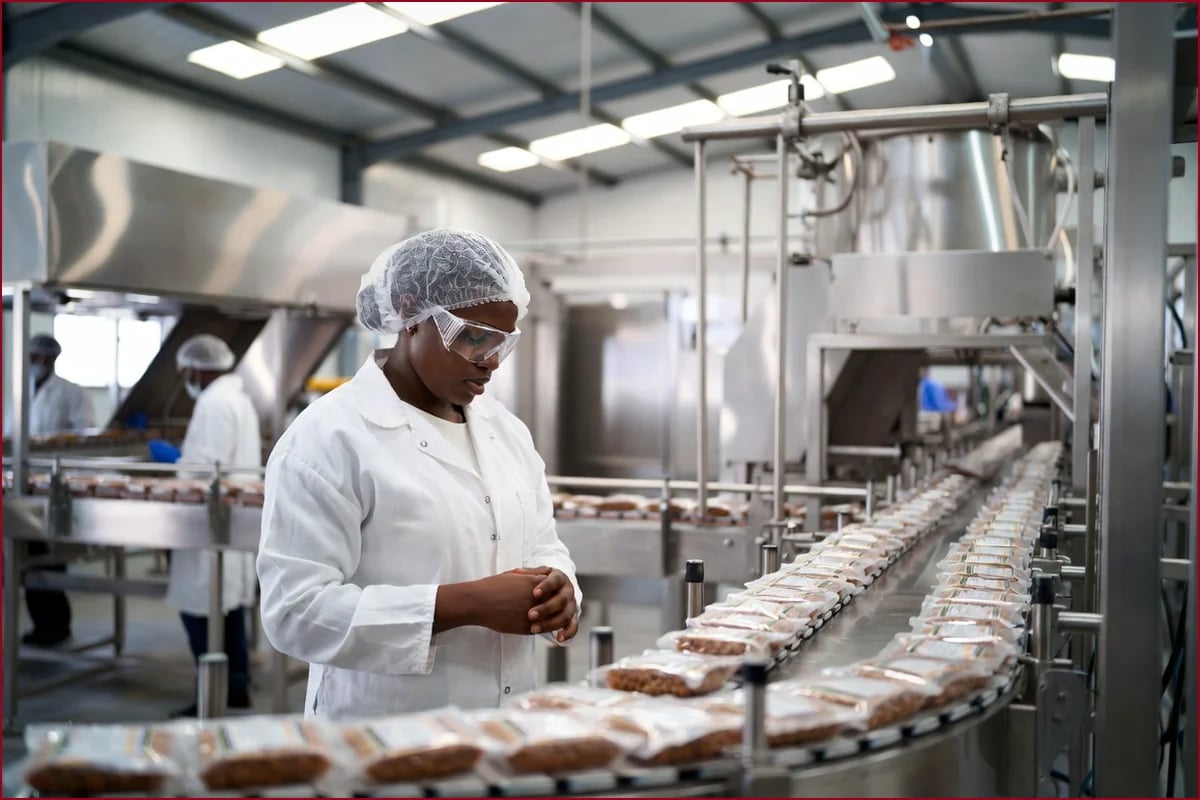
Why Food Processors Specify Kronix Agri
Food-processing operations are only as consistent as the raw materials arriving at their intake bay. Variability in moisture content, contamination thresholds, sizing uniformity and harvest-cycle timing cascades directly into production yield, equipment calibration and finished-product quality — consequences a serious processor cannot absorb. Kronix Agri is structured to remove that variability at source, aggregating tropical crops across Ghana and Togo through a discipline of documentation and quality control that begins at the farm gate and closes only when verified, graded product is formally handed over to the processing facility.
Where commodity markets deliver anonymous bulk, Kronix Agri delivers traceability. Each consignment moves through a recorded sequence — aggregation, primary sorting, moisture and grade assessment, conditioning where required, and logistics handover — with documentation that a food processor’s intake team, quality assurance function, or institutional auditor can review at any stage. For operations running continuous processing lines, that level of supply discipline is not a convenience; it is the foundation on which production planning is built.
Specification Requirements Unique to Food Processing
Food processors operating under buyer mandates, export-market standards, or development-programme supply contracts carry specification burdens that generic commodity traders are not equipped to meet. Intake specifications typically govern moisture ceilings, foreign-matter tolerances, aflatoxin and microbial thresholds, and minimum grade consistency across successive deliveries. A single non-conforming consignment can suspend a production run, trigger a buyer audit, or place a processor’s export certification at risk.
Kronix Agri’s aggregation and processing workflow is designed around these downstream requirements from the outset. Crop selection, aggregation-point hygiene protocols, sorting parameters and conditioning steps are calibrated to the processor’s intake specification — not to a generic market grade. In contexts where a food processor sources across both Ghana and Togo simultaneously, Kronix Agri coordinates supply across both corridors with unified documentation standards, ensuring that provenance and quality data are consistent regardless of origin geography.
Recommended Services for Food Processors
- Specification-Grade Crop Aggregation — Systematic sourcing and consolidation of tropical crop volumes calibrated to the processor’s stated intake parameters across Ghana and Togo
- Export-Readiness Processing and Conditioning — Primary sorting, moisture management and grading aligned to food-grade intake thresholds before delivery
- Traceability Documentation and Handover Packages — Consignment-level records covering origin, aggregation point, quality assessment results and chain-of-custody for processor intake and audit purposes
- Agro-Logistics Coordination — Managed inland movement from aggregation points to processor intake facilities, with scheduling aligned to production-line requirements
- Institutional Supply Programme Advisory — Structured engagement for processors building medium- and long-cycle procurement programmes with development organisations or export-market buyers
Notable Project Types
Kronix Agri has supported food-processing supply programmes requiring structured, multi-cycle delivery of tropical crops into intake facilities operating under consistent production schedules. Typical engagements involve initial specification alignment — where the processor’s quality and procurement team works directly with Kronix Agri to define the aggregation and conditioning parameters — followed by phased delivery across an agreed supply period, with quality documentation issued at each handover. These programmes are particularly well-suited to processors whose buyers require traceability records as a condition of supply.
A second recurring project type involves processors transitioning from open-market procurement to structured aggregation supply — often prompted by buyer requirements, institutional programme enrolment, or a quality incident in a prior supply cycle. In these engagements, Kronix Agri conducts an intake specification review, maps the appropriate aggregation sources across the relevant corridor within Ghana or Togo, and builds a phased supply plan that allows the processor’s quality function to validate consistency before full programme volumes are committed.
Compliance and Standards Orientation
- Consignment-level documentation at every stage from aggregation to intake handover
- Quality assessment aligned to processor-specified moisture, grade and contamination tolerances
- Traceability records structured for buyer audit and institutional programme reporting
- Hygiene and handling protocols maintained at aggregation and conditioning points
- Unified documentation standards across Ghana and Togo supply corridors
- Intake-aligned scheduling to support continuous processing line requirements
Sourcing for Food Processors
The aggregation and quality services that keep an intake bay consistent:
- Crop Aggregation & Export Facilitation — the full source-to-shipment service
- Crop Aggregation & Sourcing — documented, traceable origin supply
- Post-Harvest Handling & Cold Chain — quality preserved from farm gate
- Quality Assurance & Grading — to processor intake specification
- Export-Readiness & Certification Support — phytosanitary and documentation
Compliant & To Standard
Kronix Agri is an aggregation and export-facilitation partner — not a plantation. We source from smallholder farmers and cooperatives and prepare the crop to a documented standard. We work within the relevant Ghanaian regulatory regime for each crop (the Tree Crops Development Authority for crops such as cashew and shea, COCOBOD’s licensed regime for cocoa, and PPRSD phytosanitary requirements for export), and we describe our role and certifications honestly — never a licence or standard we do not hold. Where standards such as GLOBALG.A.P or HACCP apply, we support readiness toward them and state plainly what is held versus in progress.
Discuss a sourcing partnership — or request a proposal: +233 20 531 3333.