The problem
Institutional buyers need a documented, HSE-disciplined source for contract-farming coordination.
Our approach
Contract-Farming Coordination
Contract-Farming Coordination delivered to institutional standard — structured procurement, chain-of-custody discipline, documented handover.
The Challenge
Sourcing tropical crops at volume — with the documentation discipline that export windows, food-safety audits, and institutional procurement desks require — remains one of the most structurally underdeveloped capabilities across the Ghana–Togo agricultural corridor. Buyers carry specification sheets. Farmers carry knowledge. Between them sits a disorganised middle layer of informal aggregation, undocumented handovers, and chain-of-custody gaps that routinely disqualify otherwise viable product at the point of export or factory intake.
For food processors and institutional buyers, the consequence is not merely inconvenience — it is programme delay, quality variance, and the compounding cost of re-inspection. For development programmes and offtake partners working against seasonal windows, that exposure is structural. A single undocumented consignment can unwind months of supply planning.
The deeper problem is coordination architecture. Contract farming as a model is well understood in principle; in practice, it collapses without a disciplined intermediary capable of holding grower commitments, enforcing production protocols, and delivering crop volumes with the traceability record an institutional buyer expects at intake. That intermediary function is precisely what most supply chains across Ghana and Togo lack.
The Kronix Agri Solution
Kronix Agri structures contract-farming arrangements as a managed coordination service — not a brokerage and not a speculative aggregation play. Engagement begins with buyer-specification alignment: understanding the crop profile, quality parameters, pack-out requirements, and documentary standards the receiving institution or export facility demands. That specification is then translated into grower-facing production protocols, enforced across registered smallholder and mid-scale farm clusters in the relevant production zones of Ghana and Togo.
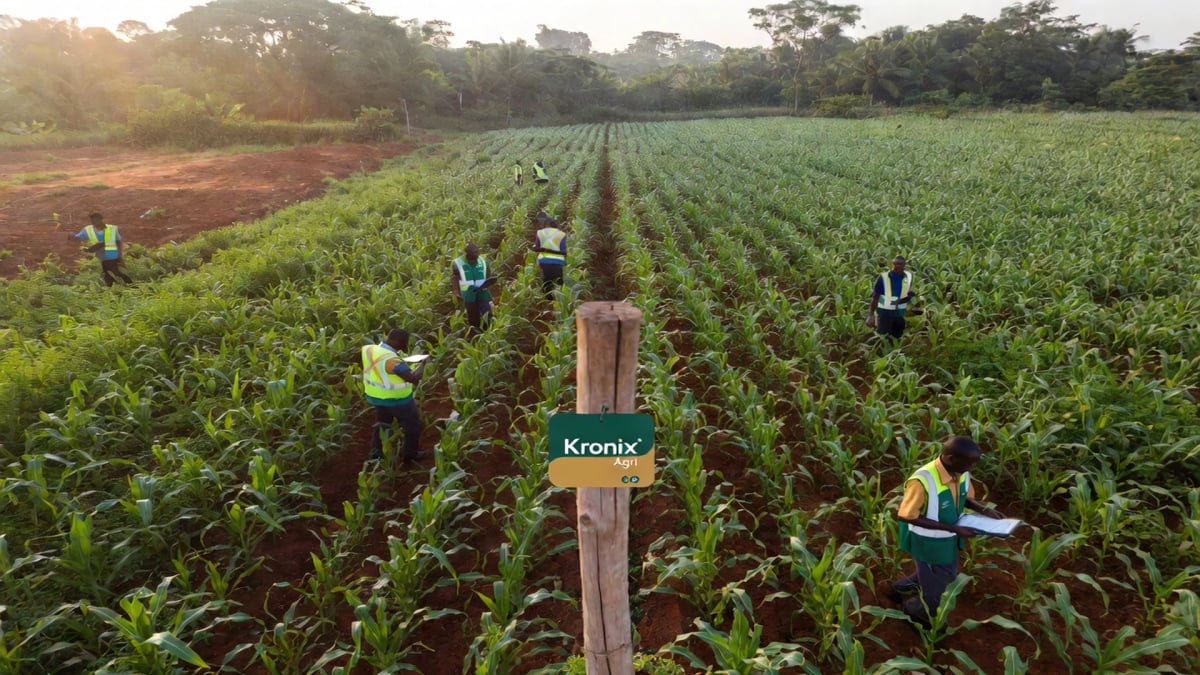
Throughout the growing cycle, Kronix Agri field coordinators maintain documented touchpoints at key agronomic milestones — input application, canopy development, pre-harvest assessment, and harvest readiness confirmation. Each handover stage is recorded and reconciled against the original buyer specification, so that what reaches the aggregation point is traceable back to the field-level commitment it was contracted against.
The result is a coordinated supply pipeline that behaves with the predictability an institutional intake desk requires: known volumes, documented provenance, quality-verified crop, and a chain-of-custody record that travels with the consignment from field gate to delivery point.
Process and Programme Specification
- Grower registration and field mapping across production zones in Ghana and Togo
- Buyer-specification translation into grower-facing production protocols and input schedules
- Field coordinator touchpoints at defined agronomic milestones with documented sign-off at each stage
- Pre-harvest quality assessment against buyer parameters before mobilisation
- Chain-of-custody records issued at every handover point — field to aggregation, aggregation to processing or export staging
- Reconciliation reporting provided to the institutional buyer at programme close
Typical Programme Profile
A standard contract-farming coordination engagement covers a defined crop cycle aligned to a specific buyer offtake commitment — typically structured around tropical commodities including cocoa, cashew, soya, shea, or selected horticulture crops within viable production zones across Ghana and Togo. Programme scope scales from pilot-volume trials for new supply relationships through to full-season coordination for established institutional offtakers and development-programme procurement desks. Timeline is structured to the crop calendar, with coordination activity commencing well ahead of planting to allow grower registration, protocol briefing, and input-readiness confirmation before the agronomic window opens.
Outcomes
- Institutional buyers receive documented, specification-aligned crop with a chain-of-custody record at delivery
- Export and factory intake processes proceed without the quality-gap delays common to informally aggregated supply
- Grower clusters build repeatable production discipline, improving offtake reliability across successive seasons
- Development programmes and procurement desks gain a coordinated supply partner capable of operating against formal programme documentation requirements
- The buyer-grower relationship is underpinned by a structured intermediary layer — reducing exposure to the volume and quality variance that characterises uncoordinated sourcing across the corridor