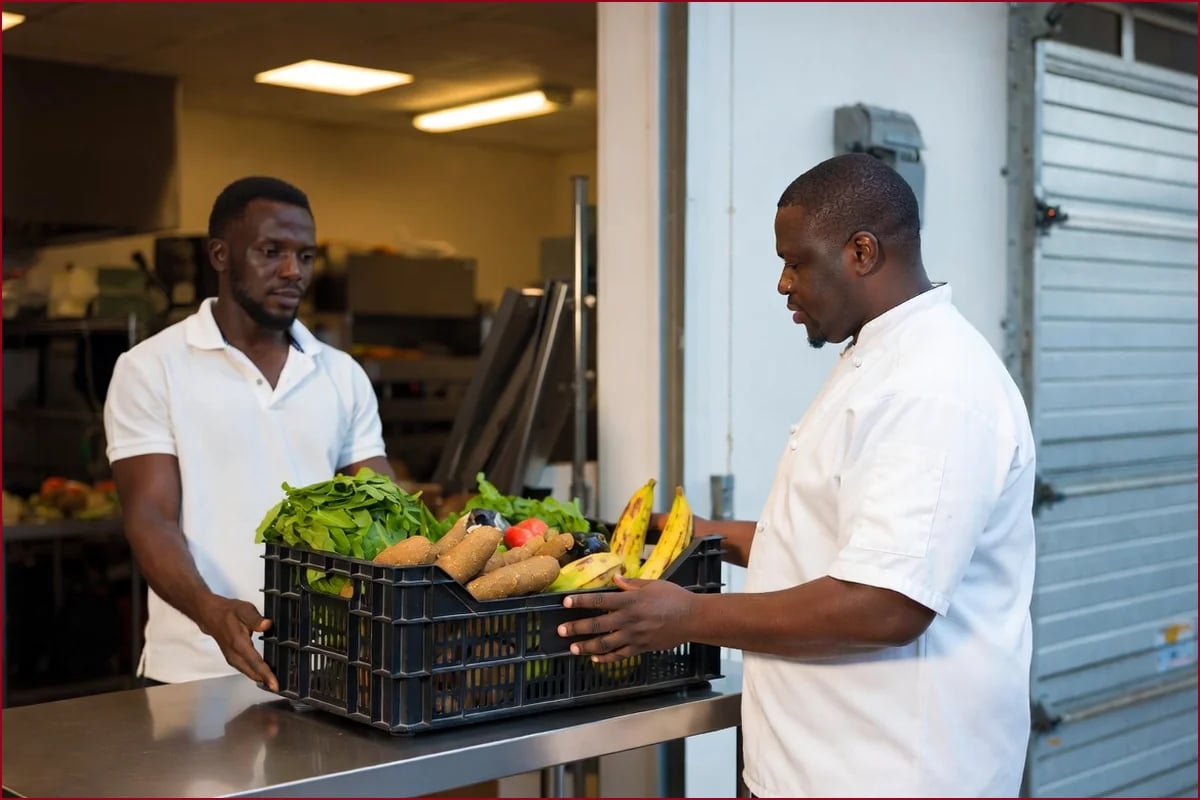
Why Hospitality & Food Service Operations Specify Kronix Agri
Hospitality and food-service operations run on consistency. A hotel kitchen serving breakfast to three hundred covers cannot absorb variance in cassava flour moisture content. A catering group servicing diplomatic functions cannot reconcile lot-to-lot differences in dried chilli grade. Kronix Agri exists precisely at this intersection — where the agricultural supply chain meets the operational precision that institutional kitchens, hotel commissaries, and food-service procurement desks require.
The discipline embedded in Kronix Agri’s aggregation and processing protocols means that each consignment reaching a hospitality buyer carries documented provenance, consistent grading, and the traceability records that modern food-service compliance demands. From sourcing networks across Ghana and Togo through to export-readiness processing, the supply logic is built to perform at the specification levels that premium hospitality groups and institutional catering programmes procure against — not against a spot-market convenience, but against a documented supply standard.
Specification Requirements Unique to Hospitality & Food Service
Institutional food-service procurement places demands that general commodity trading rarely satisfies. Grading must be tight and repeatable across successive orders — a five-star property cannot serve inconsistent product under a consistent menu. Moisture thresholds, foreign matter tolerances, and pack formats must all be specified upfront and documented at each handover point. Allergen segregation, cross-contamination controls, and cold-chain integrity for perishable lines add further layers of process discipline that general-purpose aggregators are not configured to meet.
Regulatory compliance compounds these operational requirements. Buyers operating within formal hospitality chains — particularly those serving international visitors or operating under franchise standards — must satisfy food-safety documentation requirements that trace product from farm origin through processing to delivery. In Ghana and across the Togo corridor, these documentation expectations are rising in line with international buyer standards. Kronix Agri’s traceability-disciplined supply chain is designed to produce the documentation sets these procurement environments require, at the frequency institutional buying schedules demand.
Recommended Services for Hospitality & Food Service
- Export-Readiness Processing — Cleaning, drying, grading, and pack formatting to specification, producing commodity lots matched to hospitality procurement briefs.
- Crop Aggregation — Structured sourcing from verified producer networks across Ghana and Togo, assembled into consistent-grade consignments for high-frequency institutional buyers.
- Traceability Documentation — Lot-level records tracking origin, processing stage, and handover points — the documentation layer that food-service compliance audits require.
- Agro-Logistics Coordination — Inland movement and staging logistics aligned to hospitality supply schedules, reducing lead-time variance for standing orders.
- Procurement Advisory — Specification support for hospitality and catering procurement teams building structured supply programmes for tropical commodity categories.
Notable Project Types
Kronix Agri has structured supply programmes for institutional food-service operations requiring standing deliveries of specification-grade tropical commodities — shea, cassava derivatives, dried peppers, and legume categories among them. A recurring engagement type involves premium hotel groups and corporate catering operations commissioning documented supply of processed commodity lots for kitchen use, where grading consistency and lot traceability are non-negotiable procurement conditions. These arrangements are built around supply briefs agreed ahead of the season, with documentation protocols aligned to the buyer’s own quality management procedures.
Development-programme-linked food service represents a second pattern — institutional catering operations attached to school feeding schemes, healthcare facilities, or large-scale event catering in Ghana and Togo, where commodity volumes are significant, documentation expectations are formal, and the consequences of supply disruption carry institutional weight. In these contexts, Kronix Agri’s structured aggregation and logistics coordination disciplines deliver a supply reliability that spot-market sourcing cannot match.
Compliance & Standards
- Lot-level traceability documentation from farm origin through processing and delivery handover
- Grading specifications maintained consistently across successive consignments within a supply programme
- Moisture, foreign matter, and purity tolerances documented per agreed procurement brief
- Allergen and cross-contamination segregation protocols applied at processing stage
- Food-safety documentation produced in formats compatible with institutional hospitality audit requirements
- Supply programme records retained and available for buyer compliance review across the Ghana and Togo operating corridor
Sourcing for Hospitality & Food Service
The aggregation and quality services behind a consistent, documented kitchen supply:
- Crop Aggregation & Export Facilitation — the full source-to-shipment service
- Crop Aggregation & Sourcing — documented, traceable origin supply
- Post-Harvest Handling & Cold Chain — quality preserved from farm gate
- Quality Assurance & Grading — consistent grade across orders
- Export-Readiness & Certification Support — phytosanitary and documentation
Compliant & To Standard — Honestly
Kronix Agri is an aggregation and export-facilitation partner — not a plantation. We source from smallholder farmers and cooperatives and prepare the crop to a documented standard. We work within the relevant Ghanaian regulatory regime for each crop (the Tree Crops Development Authority for crops such as cashew and shea, COCOBOD’s licensed regime for cocoa, and PPRSD phytosanitary requirements for export), and we describe our role and certifications honestly — never a licence or standard we do not hold. Where standards such as GLOBALG.A.P or HACCP apply, we support readiness toward them and state plainly what is held versus in progress.
Discuss a sourcing partnership — or request a proposal: +233 20 531 3333.