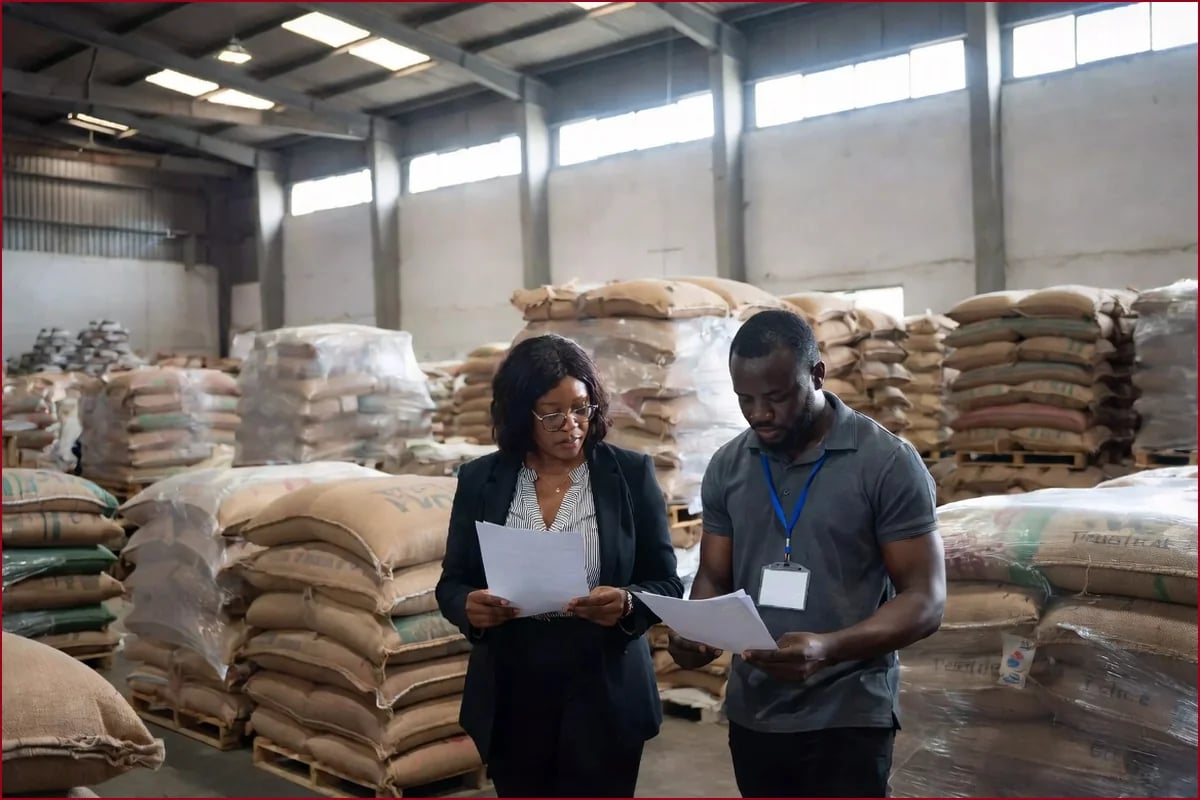
Why Institutional Procurement Operations Specify Kronix Agri
Institutional procurement at scale demands more than commodity availability — it demands documented supply chains, consistent quality at every handover, and a partner whose traceability protocols hold under due-diligence review. Kronix Agri operates at precisely this tier. Aggregating tropical crops across Ghana and Togo through networks governed by specification protocols rather than spot-market opportunism, the organisation services exporters, food processors, institutional buyers, and development programme operators who cannot accept undocumented origin or inconsistent grade.
The distinction is operational: where informal aggregation introduces grade variance and documentation gaps, Kronix Agri structures each supply programme around handover documentation, quality checkpoints, and processing that prepares commodities for the exacting requirements of international buyers and domestic food-manufacturing operations alike. Procurement teams and supply-chain officers engage with an organisation whose working method mirrors the rigour their own compliance frameworks demand.
Specification Requirements Unique to Institutional Procurement
Institutional procurement — whether driven by export-licence obligations, food-safety due diligence, development programme sourcing criteria, or corporate sustainability reporting — carries regulatory weight that informal aggregators cannot satisfy. Traceability to origin, phytosanitary clearance documentation, moisture and aflatoxin compliance records, and packing standards aligned to destination-market requirements are baseline expectations, not optional add-ons. Procurement officers operating under World Food Programme sourcing guidelines, European Union import regulations, or West African regional food-safety frameworks require supply partners whose process documentation is audit-ready.
Kronix Agri’s operating model within Ghana and Togo is constructed around this expectation. Aggregation, grading, drying, sorting, and logistics handovers are documented at each stage — producing the supply-chain paper trail that institutional buyers require for regulatory submission, internal audit, and sustainability reporting.
Recommended Supply Programmes for Institutional Procurement
- Traceable commodity aggregation — structured collection from verified growing areas across Ghana and Togo, with documented origin and quality records at intake
- Export-readiness processing — grading, drying, sorting, and packing executed to destination-market specifications for food processors and export-licence holders
- Institutional supply programme management — scheduled, volume-consistent supply arrangements designed for procurement operations requiring reliable forward planning
- Phytosanitary and documentation support — preparation and organisation of the compliance documentation required by institutional buyers, export authorities, and development programme procurement offices
- Agro-logistics coordination — coordinated inland movement and handover logistics across the Ghana-Togo corridor, managed with full custody documentation
Notable Supply Programme Types
Kronix Agri’s institutional work spans supply programmes structured for sustained delivery rather than single transactions. A representative pattern is the multi-season supply arrangement designed for a regional food-processing operation requiring consistent quality across successive procurement cycles — where intake protocols, grading standards, and documentation formats are agreed in advance and maintained throughout. Another characteristic engagement is the export-readiness programme developed for an aggregator preparing shipments for European buyers, where processing, compliance documentation, and packing are aligned to destination phytosanitary and labelling requirements from the outset.
Development programme procurement — supporting nutritional or food-security initiatives requiring traceable, domestically sourced commodities — represents a distinct and operationally demanding programme type. These engagements require supply-chain documentation at a level of granularity that exceeds commercial export standards, and Kronix Agri’s documentation protocols are designed to meet that requirement without exception.
Compliance and Standards Framework
- Origin traceability documentation maintained from aggregation intake through final handover
- Phytosanitary compliance records prepared in accordance with Ghana and Togo export-authority requirements
- Quality inspection records covering moisture content, foreign matter, and grade classification at each processing stage
- Packing and labelling standards aligned to destination-market regulatory requirements for export consignments
- Custody-transfer documentation at each logistics handover point along the Ghana-Togo corridor
- Supply programme records structured to support third-party audit, development programme reporting, and institutional due-diligence review
Sourcing for Institutional Buyers
The aggregation and documentation services that hold under due-diligence review:
- Crop Aggregation & Export Facilitation — the full source-to-shipment service
- Crop Aggregation & Sourcing — documented, traceable origin supply
- Post-Harvest Handling & Cold Chain — quality preserved from farm gate
- Quality Assurance & Grading — to procurement specification
- Export-Readiness & Certification Support — phytosanitary and documentation
Compliant & To Standard — Honestly
Kronix Agri is an aggregation and export-facilitation partner — not a plantation. We source from smallholder farmers and cooperatives and build the documented, traceable supply institutional procurement requires. We work within the relevant Ghanaian regulatory regime for each crop (the Tree Crops Development Authority for crops such as cashew and shea, COCOBOD’s licensed regime for cocoa, and PPRSD phytosanitary requirements for export), and we describe our role and certifications honestly — never a licence or standard we do not hold. Where standards such as GLOBALG.A.P or HACCP apply, we support readiness toward them and state plainly what is held versus in progress.
Discuss a sourcing partnership — or request a proposal: +233 20 531 3333.