The problem
Institutional buyers need a documented, HSE-disciplined source for agro-logistics & distribution.
Our approach
Agro-Logistics & Distribution
Agro-Logistics & Distribution delivered to institutional standard — structured procurement, chain-of-custody discipline, documented handover.
The Challenge
Across Ghana and Togo, agricultural produce moves through fragmented distribution channels where documentation gaps, inconsistent cold-chain discipline and uncoordinated handover points create compounding risk for buyers who operate to institutional standards. For exporters filing phytosanitary declarations, food processors managing supplier audits and development programme procurement officers reconciling field volumes against contract tonnage, a single undocumented break in the logistics chain is sufficient to trigger rejection, delay or compliance exposure.
The structural reality of West African agro-logistics is that transport, storage, consolidation and delivery are typically handled by separate actors with no shared traceability framework. Produce changes hands through informal arrangements, weight discrepancies accumulate unacknowledged and quality variance between farm gate and point of despatch is rarely captured with enough granularity to be actionable. Institutional buyers increasingly require documentation that travels with the cargo — not accounts produced after the fact.
A credible agro-logistics function must therefore operate less like a haulage arrangement and more like a managed chain of custody. Every handover must be witnessed, recorded and reconcilable. Quality parameters must be captured at intake, at consolidation and at dispatch. The logistics layer is not separate from the quality assurance layer — it is an extension of it.
The Kronix Agri Solution
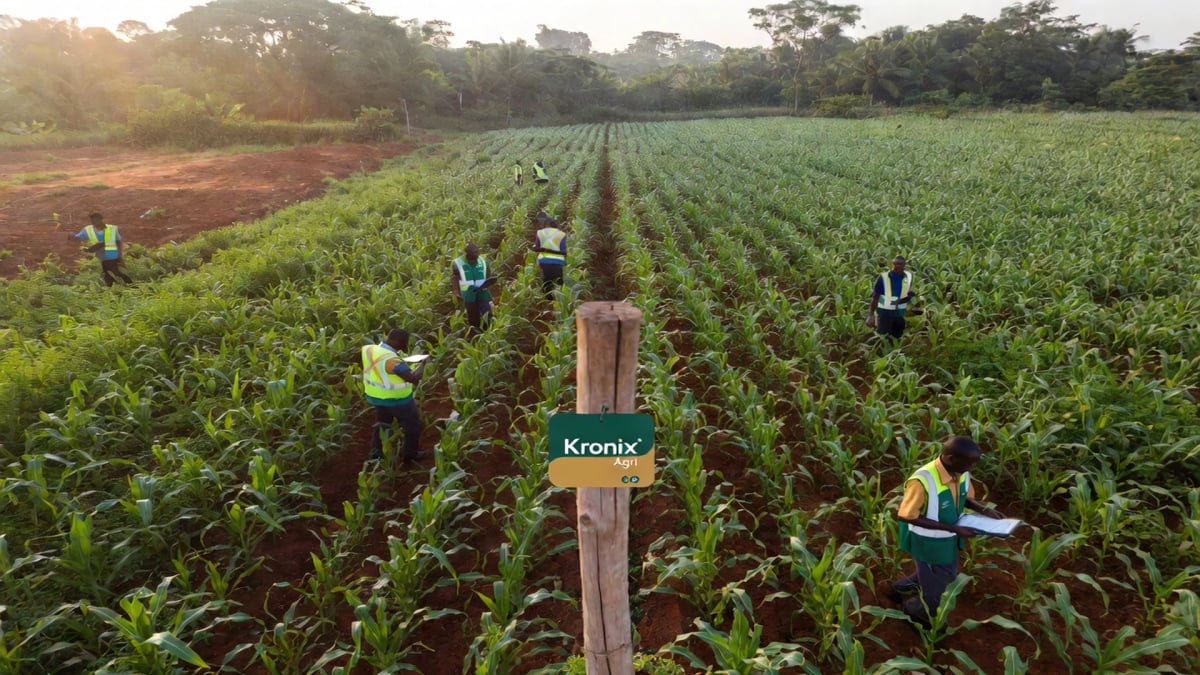
Kronix Agri structures its agro-logistics and distribution function around documented chain-of-custody discipline applied from aggregation point through to the institutional buyer’s nominated delivery location across Ghana and Togo. Rather than coordinating transport as a standalone service, the approach integrates logistics scheduling directly with the upstream crop aggregation and export-readiness processing programmes — ensuring that what is loaded, moved and delivered corresponds precisely to the specification set at source.
Each movement is governed by a handover documentation protocol. Intake volumes are recorded against agreed specification parameters. Consolidation is managed at designated staging points where secondary quality checks occur before onward movement. Dispatch documentation is prepared in formats aligned to the receiving institution’s procurement and compliance requirements — whether that is an export house, a food processing facility or a programme-funded distribution network operating across the corridor.
Transport routing, vehicle condition standards and storage-in-transit protocols are managed to maintain produce integrity across the road conditions and ambient temperature ranges characteristic of the Ghana-Togo corridor. The logistics function is calibrated to the biological timeline of the crops in movement, not simply to generic freight scheduling.
Process + Chain-of-Custody Specification
- Documented intake recording at aggregation point: variety, weight, grade classification and quality observation notes
- Multi-point quality check protocol applied at consolidation staging and pre-dispatch
- Handover documentation prepared in formats aligned to institutional buyer requirements — including export-facing paperwork where applicable
- Transport scheduling matched to crop perishability windows and receiving facility intake calendars
- Chain-of-custody reconciliation: each dispatch traceable back to originating aggregation lot
- Discrepancy management protocol: variance between contracted and delivered volumes documented and escalated through defined channels, not absorbed silently
Typical Engagement Profile
Engagements typically involve institutional buyers — export houses, mid-to-large food processors, development programme procurement teams — requiring structured, documented supply of specific tropical crop varieties across the Ghana-Togo corridor. Scope commonly spans periodic or continuous supply schedules rather than single movements, with handover documentation requirements specified in advance as part of the procurement agreement. Logistics coordination is built around the buyer’s receiving calendar and compliance documentation needs, with Kronix Agri managing the aggregation-to-delivery chain as an integrated function rather than a patchwork of separate contractors.
Outcomes
- Institutional buyers receive cargo accompanied by complete chain-of-custody documentation, reducing compliance exposure at point of receipt
- Quality parameters are captured at multiple handover points, creating an auditable record that supports supplier verification requirements
- Logistics scheduling aligned to crop perishability and buyer intake calendars reduces post-transit quality degradation
- Volume reconciliation discipline at each handover stage eliminates undocumented discrepancies between contracted and delivered quantities
- Procurement officers and compliance teams gain a logistics partner whose documentation output is structured to meet institutional audit and reporting standards