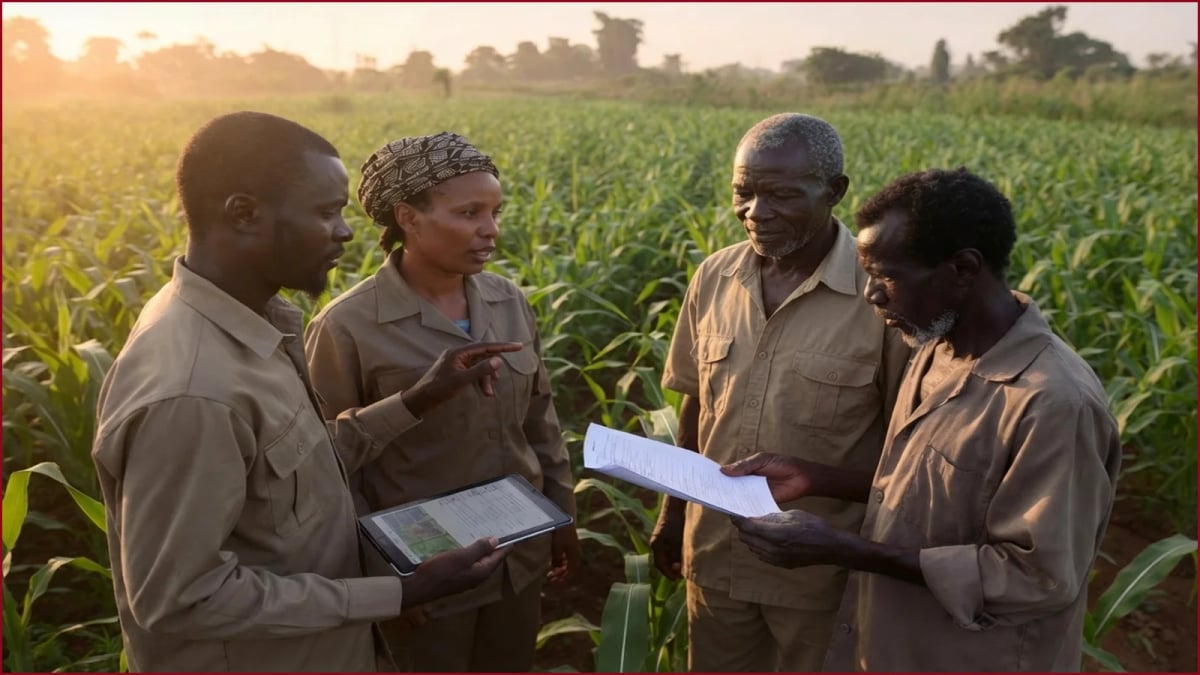
Contract-farming programme with a farmer cooperative network
A cooperative network sought structured sourcing arrangements aligned to export-market quality standards. The Project Office coordinated contract-farming agreements, agronomy advisory and commodity aggregation from the cooperative's production area.
Project Profile
Sector: Smallholder aggregation and export-readiness processing Programme Scale: Multi-district cooperative network across two supply corridors — Ghana and Togo Scope: Contract-farming architecture, agronomic advisory, graded aggregation, traceability documentation, and export-readiness processing Timeline: Rolling seasonal engagement across multiple harvest cycles
The Specification Challenge
The client — a regional food processor with institutional export commitments — required a reliable, graded supply of tropical crops that met the documented quality standards demanded by their off-take partners. The structural challenge was not crop availability. Produce moved through the corridor. The challenge was discipline: smallholder networks operating without consistent agronomic protocols, harvest timing misaligned with processing schedules, and no chain-of-custody documentation capable of satisfying institutional buyer requirements.
Informal aggregation had failed the client before. Volume arrived. Quality did not. Traceability was absent. The off-take window was fixed. The programme needed redesign from the field forward.
The Approach
Kronix Agri engaged the cooperative network at the field level — not the warehouse level. The programme was structured in three discipline layers.
Contract-farming architecture. Standardised agreements were drawn between the programme and registered cooperative members, establishing planting schedules, input protocols, and harvest-trigger criteria. Each participating farmer unit operated under documented obligations, with agreed handover conditions tied to grade specifications rather than bulk volume.
Agronomic protocol integration. Field-level advisory visits were scheduled at critical crop stages. Rather than post-harvest inspection only, quality discipline was built into pre-harvest practice — spacing, input timing, and maturity-index assessment before any crop moved to the aggregation point.
Graded aggregation and traceability documentation. At each collection point, produce was assessed against the agreed grade specification before acceptance. Rejected lots were documented separately to preserve batch integrity. Handover records — cooperative unit, collection point, date, grade, quantity — were generated at every transfer stage, creating the chain-of-custody the client’s export-readiness processing required.
Export-readiness processing was then applied to accepted stock: cleaning, sorting, moisture management, and primary packaging under documented conditions, with each processed batch traceable to its origin cooperative cluster.
The Outcome
The programme delivered the client’s processing facility a consistent, graded, documented supply across successive harvest cycles. Rejection rates at the processing stage declined materially as agronomic discipline upstream reduced the volume of non-conforming crop reaching aggregation points. The client’s institutional buyers received traceability documentation meeting their import-market standards — documentation that had previously been unavailable through informal aggregation channels.
The cooperative network, operating under a structured contract framework for the first time, demonstrated sustained adherence to harvest-timing and quality protocols across the programme duration.
What This Project Demonstrates
Export supply chains for tropical crops do not fail at the port. They fail at the field — when agronomic discipline is absent, when aggregation is informal, and when traceability is treated as a post-hoc paperwork exercise rather than a live operational discipline.
This programme demonstrates that when contract structure, agronomic advisory, and graded aggregation are integrated from the first field interaction, smallholder cooperative networks are capable of supplying to institutional export standards consistently and repeatedly. The methodology scales. The documentation holds. The off-take window is met.
That is the institutional standard Kronix Agri builds into every supply corridor it operates.