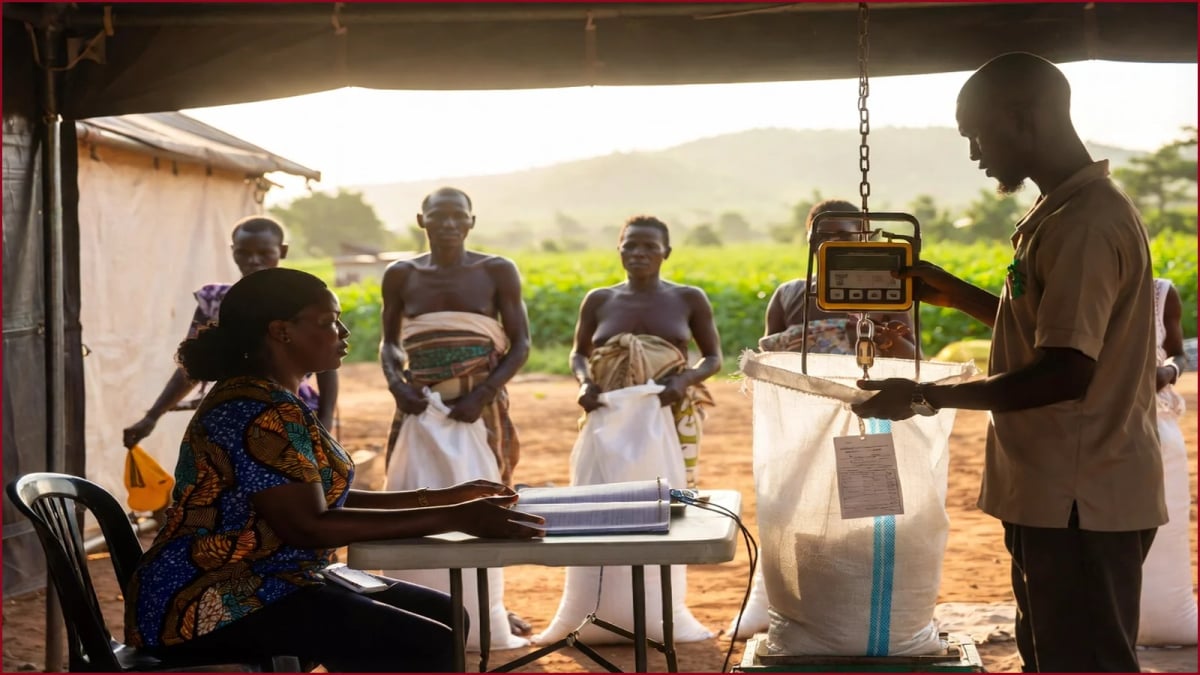
Commodity aggregation support for a government agricultural programme
A government agricultural development programme required structured commodity aggregation and agronomy support for a smallholder outgrower scheme. The Project Office provided sourcing coordination, advisory inputs and documented collection across the programme area.
Project Profile
Sector: Government agricultural development programme — smallholder-linked commodity aggregation Scale: Multi-district sourcing network across two growing regions Scope: Aggregation coordination, post-harvest handling protocol, export-readiness processing, documentation and traceability management Timeline: Single crop season with programme handover at season close
A national government agricultural programme operating across several production districts in Ghana required a disciplined commodity aggregation partner for its smallholder-linked supply chain. The programme’s mandate called for produce collected across disaggregated farm communities to be consolidated, processed to export-readiness standards, and delivered to a central intake point with full batch-level traceability documentation. The institutional buyer at the receiving end required compliance with international phytosanitary benchmarks — demanding a level of operational rigour beyond what ad hoc trading arrangements could sustain.
The Aggregation Challenge
The programme presented several compounding pressures that made informal sourcing arrangements unsuitable.
Smallholder output across the participating districts was harvested across staggered windows, creating supply timing variability that required coordinated collection scheduling rather than reactive purchasing. Quality consistency across batches was uneven — the gap between farm-gate condition and export-readiness specification was significant, requiring structured post-harvest intervention at every collection point.
Documentation was the most acute institutional requirement. The receiving buyer demanded batch-level records that traced each consignment from farm community to intake point: collection date, handling method, moisture-check results, and responsible custodian at each handover stage. No single document gap was acceptable. The programme’s credibility as an institutional actor depended on the integrity of this paper trail.
Approach
Kronix Agri deployed a coordinated aggregation protocol designed specifically for multi-source, documentation-intensive mandates of this type.
Collection was organised by district cohort, with defined harvest windows communicated to community aggregation points in advance. Each batch received post-harvest handling according to a standardised protocol — cleaning, sorting, moisture assessment and primary grading — before consolidation at a designated processing point.
Traceability documentation was generated at every handover: farm community to collection point, collection point to processing facility, processing facility to final intake. Each stage produced a verified record tied to a batch identifier. The full document set accompanied the consolidated consignment to the programme’s receiving authority, providing the institutional audit trail the buyer required.
Throughout the season, quality performance was monitored against the export-readiness benchmarks agreed at programme onboarding, with any out-of-specification batches quarantined and addressed before entering the final consolidation.
Outcome
The programme’s seasonal commodity requirement was fulfilled within the agreed timeline. The receiving authority accepted the consolidated consignment with its full traceability documentation set intact — no batch-level records were absent or incomplete at handover. Post-harvest quality losses across the aggregated volume were materially reduced compared to the programme’s prior season experience with less structured arrangements.
The programme’s development coordinator noted that the documentation discipline maintained throughout the season positioned the initiative favourably for renewal discussions with its institutional funding partners.
What This Project Demonstrates
Government agricultural programmes and development mandates operate under institutional accountability standards that informal commodity trading cannot satisfy. Funding partners, international buyers and government oversight bodies require documented traceability, not assurances.
This project reflects a recurring pattern across publicly-funded agricultural initiatives in Ghana: the gap between smallholder production capacity and institutional buyer requirements is primarily a logistics, handling and documentation gap — not a production gap. Where that gap is managed with the discipline institutional procurement demands, programmes deliver. Where it is not, consignments stall, funding reviews surface, and seasonal gains are lost.
Kronix Agri is built for precisely this structural role.