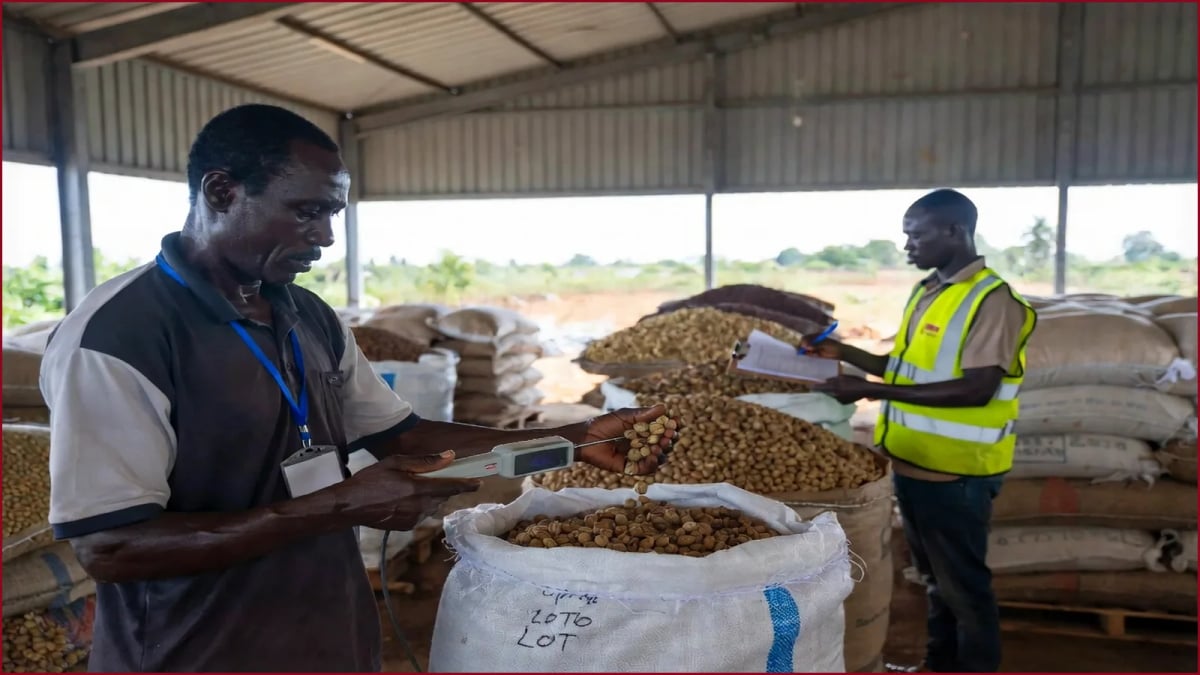
Commodity aggregation programme for an export operation
An export operation required structured aggregation of tropical crops across a dispersed smallholder network. The Project Office coordinated farm-gate sourcing, grading and export-readiness processing with documentation at each handover stage.
Project Profile
Sector: Dried and semi-processed tropical commodities — export channel
Scope: Multi-origin aggregation, grading, moisture management, export-readiness processing and logistics coordination
Operational Geography: Southern Ghana producing zones into Accra export corridor; secondary sourcing from Togo border-adjacent districts
Programme Duration: Seasonal engagement across two successive harvest cycles
A licensed export operation with established European and Middle Eastern buyer relationships engaged Kronix Agri to restructure the upstream end of its supply chain. The operation had the commercial relationships. It lacked the on-ground aggregation discipline to fill those relationships with consistent, documentable commodity.
The Specification Challenge
The client’s buyers operated to tight specification windows — moisture thresholds, grade profiles, and lot-level traceability documentation were non-negotiable terms of each purchase order. The previous supply arrangement had produced inconsistent lot quality, irregular volumes across delivery windows, and documentation that could not withstand buyer-side audit.
At the field level, the challenge was compounded. Smallholder and mid-scale producers across multiple districts were operating without standardised post-harvest handling. Moisture variance between lots was significant. Sorting and cleaning was inconsistent. And the handover chain from field to consolidation point was undocumented.
The operation needed the full chain — from collection-point discipline through to export-ready lot presentation — rebuilt around a specification framework its buyers would accept.
Approach
Kronix Agri deployed its aggregation programme in a structured sequence across both sourcing geographies.
At the producer level, collection points were activated with clear intake protocols — grading criteria, reject thresholds, and moisture benchmarks established at first touch. Each intake event was documented, with lot origin, volume, and condition captured at handover.
Across the consolidation phase, Kronix Agri applied its moisture management and grading methodology to incoming lots — segregating material by quality band, processing for export-readiness, and maintaining lot-level identity through the full handling sequence. No bulk blending of unverified material.
Documentation was generated continuously across the chain: intake records, processing logs, quality assessments, and lot release documentation structured to meet the format requirements of the client’s buyer agreements.
Logistics coordination brought export-ready lots to the Accra corridor in a sequence aligned to the client’s shipping schedule, with handover documentation prepared for each consignment.
The Togo-origin component was handled through an equivalent aggregation and documentation sequence, consolidated into the primary export flow at the appropriate stage.
Outcome
Across two harvest cycles, the operation was able to present consistent, specification-compliant lots to its buyers on a documented, auditable basis. Buyer-side rejections on quality grounds ceased to be a feature of the relationship. The client’s procurement team reported that documentation quality had materially improved the confidence of its European buyer contacts. The supply chain, previously a point of commercial vulnerability, became a point of commercial credibility.
What This Project Demonstrates
Export operations with strong commercial relationships frequently encounter the same structural constraint: the upstream supply chain cannot reliably produce the lot quality and documentation integrity that downstream buyers require. The gap is not commercial — it is operational.
Kronix Agri exists to close that gap. Aggregation discipline, post-harvest processing rigour, and handover documentation built to buyer-audit standard — deployed across Ghana and Togo sourcing geographies, calibrated to each client’s specification requirements.
The cultivation discipline institutions procure from.