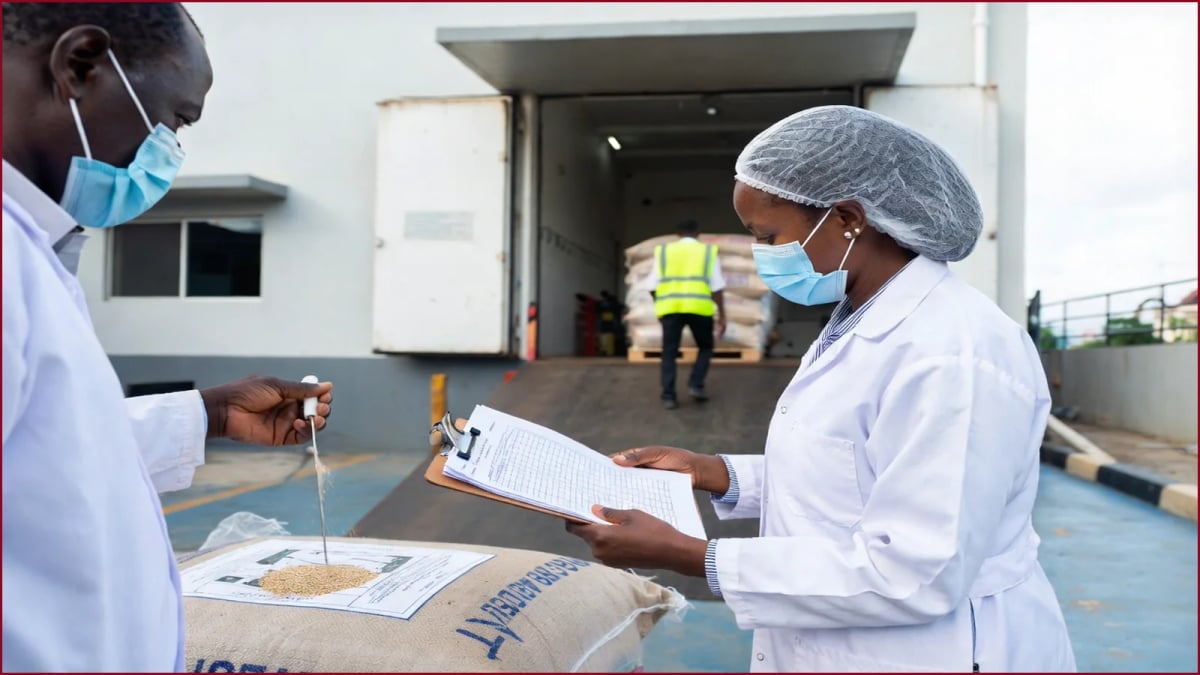
Structured commodity supply for a food-processing operation
A food-processing operation required consistent, quality-assured raw-material supply aligned to its production schedule. The Project Office structured an aggregation and delivery programme with grading documentation and verified logistics.
Project Profile
Sector: Industrial food processing — ambient-stable commodity inputs Scope: Structured multi-commodity supply programme covering sourcing, quality-sorting, moisture-conditioning and phased delivery scheduling Geography: Aggregation across Ghana and Togo; delivery to processing facility — Greater Accra Industrial Corridor Programme Duration: Sustained, multi-cycle engagement across consecutive processing seasons
A regional food-processing operation required a dependable, documentation-backed supply of tropical commodities to feed continuous production lines. Procurement volumes fluctuated with seasonal availability, and the processing operation’s scheduling tolerance was narrow — gaps in supply translated directly into halted production and penalty exposure with their own downstream clients.
The Supply Challenge
The client’s procurement team had previously managed supply through spot-market channels, accepting variable quality and inconsistent documentation as the cost of doing business. That model collapsed under production-scale pressure: moisture variances between batches caused processing inconsistencies, incomplete lot traceability created compliance exposure, and delivery unpredictability forced the operation to carry excess buffer stock — tying up working capital with no yield benefit.
The specification demand was unambiguous: commodity inputs had to arrive within defined moisture and grade parameters, fully documented, on a schedule the production calendar could be planned against.
Approach
Kronix Agri structured a programme built around aggregation discipline rather than spot acquisition. Sourcing networks across both Ghana and Togo were engaged at the farm-cluster level, with quality assessment applied at point of first aggregation — not retrospectively at the facility gate. This meant rejections and regrading decisions were resolved upstream, before logistics costs had been incurred.
Moisture conditioning was applied systematically where harvested material fell outside the client’s specification window, using controlled handling protocols that preserved commodity integrity without compromising throughput. Every lot moved through a documented handover chain: origin cluster, aggregation point, conditioning outcome, weight and grade confirmation, and delivery receipt — providing the client’s quality assurance function with a complete audit trail per consignment.
Delivery scheduling was structured around the client’s production calendar rather than supply-side convenience. Phased release from aggregation points aligned with processing line intake windows, reducing the buffer stock the client was required to hold.
Outcome
The processing operation achieved materially greater consistency in commodity intake quality across the programme period. Batch-to-batch variation narrowed to a range the processing equipment could accommodate without manual intervention. Traceability documentation satisfied internal compliance requirements and was available for third-party audit without reconstruction. The client’s procurement team reported reduction in the administrative burden previously associated with managing multiple informal suppliers and reconciling inconsistent documentation.
Supply continued without a production-halting shortfall across the engagement period, across both Ghanaian and Togolese sourcing seasons.
What This Project Demonstrates
Industrial food processors operating in West Africa face a structural problem: the informal supply chains that dominate tropical commodity markets are optimised for volume throughput, not specification discipline. Quality, documentation and scheduling are secondary considerations in spot-market dynamics.
Kronix Agri operates on the inverse logic — specification compliance and documentation integrity are the primary design of the supply programme, and volume is achieved within those constraints. For food-processing operations where production continuity and compliance exposure are genuine business risks, this distinction is not procedural. It is the condition on which reliable procurement depends.
Where a processing operation requires structured commodity supply — graded, conditioned, documented, and delivered on a schedule the production calendar can hold — this is the engagement model that delivers it.