The problem
Institutional buyers need a documented, HSE-disciplined source for quality assurance & grading.
Our approach
Quality Assurance & Grading
Quality Assurance & Grading delivered to institutional standard — structured procurement, chain-of-custody discipline, documented handover.
The Challenge
Institutional buyers — exporters, food processors, development programmes — operate under procurement mandates that demand far more than physical volume. They require documented proof that every lot transferred across a handover point meets defined quality parameters: moisture tolerance, visual grade, physical defect limits, and chain-of-custody continuity from field aggregation through to loading. Across Ghana and Togo, the gap between farm-gate reality and export-readiness specification remains one of the most consequential friction points in tropical commodity supply.
The consequences of unverified quality are structural, not incidental. A consignment rejected at a processing facility or at port imposes costs that cascade backwards through the supply chain — restaging, re-sorting, rebagging, and the erosion of institutional trust that is rarely recovered quickly. For buyers operating under offtake agreements or development programme mandates, a single undocumented lot can trigger procurement-review clauses and disqualify a supplier from future cycles.
What the sector has historically lacked is a grading and quality assurance discipline rigorous enough to satisfy institutional procurement officers — not an informal visual sort, but a structured, documented protocol that can be referenced, audited, and presented as evidence of specification compliance at every stage.
The Kronix Agri Solution
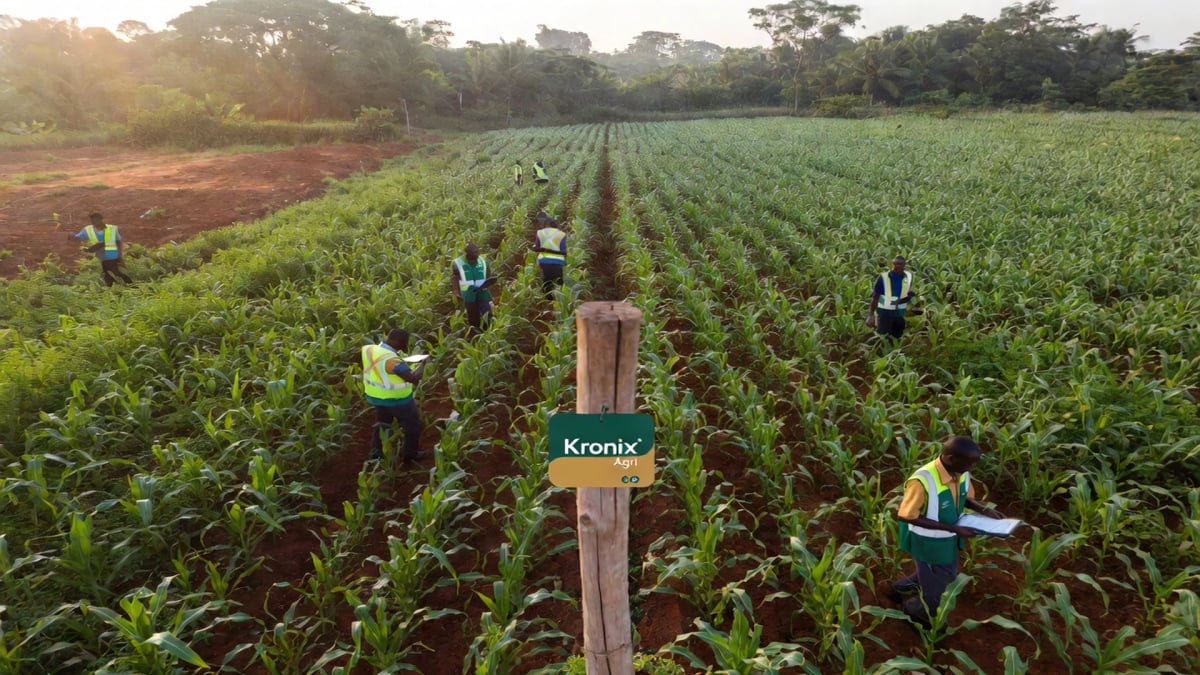
Kronix Agri applies a systematic quality assurance and grading protocol across every commodity lot it handles within its Ghana and Togo aggregation corridors. The process begins at aggregation point, where initial field-level assessment identifies lots that warrant forward movement and flags those requiring remediation before they enter the main processing stream. This upstream gate is the first formal quality checkpoint — documented, timestamped, and retained as part of the lot’s chain-of-custody record.
At processing stage, each lot undergoes structured grading against defined parameters — moisture content, foreign matter tolerance, size and colour uniformity, and physical defect classification — appropriate to the commodity and the buyer’s specification brief. Grading outcomes are recorded at each sub-stage rather than as a single terminal assessment, which means any deviation is traceable to the point at which it entered the system. This granularity is what institutional procurement officers and development programme auditors require when reviewing supplier documentation.
Handover documentation is produced for every lot transferred — internally between processing stages, and externally at the point of client or freight handover. The record set is structured to support buyer-side quality review, third-party audit, and programme reporting without requiring additional documentation effort from the receiving party.
Process + System Specification
- Field-level aggregation assessment with initial grade classification prior to inward transfer
- Stage-by-stage quality checkpoint recording across the processing sequence
- Moisture, defect, and foreign matter evaluation against buyer-provided or standard export-readiness parameters
- Chain-of-custody documentation covering every intra-facility and inter-party handover
- Lot-level traceability records structured for export documentation, institutional audit, and development programme reporting
- Remediation routing for sub-specification lots, with re-assessment documentation before re-entry into the primary stream
Typical Project Profile
A representative engagement involves a mid-to-large export consignment originating from multiple aggregation points across a defined corridor in Ghana or Togo. Kronix Agri receives the consolidated lot at processing stage, conducts structured grading across the full volume, stages remediation where required, and delivers a fully documented lot set to the client or freight forwarder at handover. Timelines are calibrated to commodity seasonality, vessel scheduling, and buyer specification review windows. The service is equally applicable to food processor intake programmes, institutional procurement tender fulfilments, and development programme quality-verification mandates.
Outcomes
- Institutional buyers receive fully documented lot records suitable for procurement audit and programme reporting without supplementary effort
- Rejection risk at processing intake or port handover is materially reduced through upstream quality gating
- Chain-of-custody continuity is maintained across every stage, from field aggregation through to final handover
- Buyers operating under offtake or development programme mandates can reference Kronix Agri’s grading documentation as evidence of specification compliance
- Remediation pathways preserve commercial value from sub-specification material rather than writing it off at point of first assessment